Updated July 2026
Reducing sodium sounds joyless. A life of bland, boring meals. It doesn't have to be. Most of the sodium you eat is hidden in packaged and restaurant food, not sprinkled on by you, so the real work is smarter shopping and a few easy swaps, not white-knuckling your way through flavorless dinners. Here's how to actually do it.
Read the label.
The nutrition panel is your single best tool, and here a simple trick makes judging sodium content easy. Nutrition facts panels are organized around 2000 calories per day and we should all be keeping our sodium intake below 2300 mg per day. These two numbers are pretty close. So, to judge whether something in the container is high in sodium, all you have to do is compare the calorie number per serving against the sodium number per serving. You don't have to worry about the units.
If the sodium number is significantly higher than the calorie number, you're looking at a higher sodium food. This does not mean you can't have the food, but you will need to make up for that higher sodium load somewhere else in your day.
Once you start checking, some labels are genuinely shocking: a slice of pizza can have 300 calories but run over 750 mg in sodium; a serving of sliced turkey breast could boast only 50 calories but stick you with 360 mg of sodium; and canned Chicken Noodle Soup? 60 calories with nearly 900 mg of sodium per serving.
Learn what the label language really means.
The marketing words on the front are not the same as the facts on the back. "Reduced sodium" only means 25% less than the original version, so if a canned soup started at 1,000 mg per serving, the "reduced" version at 750 mg is still a lot. The terms worth trusting are the specific ones: "low sodium" means 140 mg or less per serving, "very low sodium" means 35 mg or less, and "no sodium" means under 5 mg. Those are the flags to look for.
Add the good before you subtract the bad.
Don't just take salty food away, crowd it out. Deliberately add sodium-free foods, especially fresh fruits and vegetables, and eat them first. Have an apple before you dig into the pizza. It won't solve everything, but a partially filled stomach means fewer bites of the salty main event, and you come out ahead on fiber and nutrients too.
Go halfsies, and keep the salt on the outside.
You don't have to quit salted foods cold. If you love salted peanuts, mix them half and half with unsalted ones; the flavor still lands and you've cut the sodium in half. And when a food's salt sits on the surface, let your tongue do the work: dip your fork into dressing or sauce served on the side, then into the food, rather than drowning a healthy salad or plate of broccoli and undoing the point of eating it.
Cook a little more at home, and lean on herbs and spices.
When you control the ingredients, you control the salt. You don't have to cook everything, but shifting even a few meals to your own kitchen makes a real dent. Season with herbs, spices, citrus, garlic, and salt-free blends instead, and rinse canned foods like beans to wash away a good chunk of their sodium. Within a couple of months your palate resets, and the heavily salted versions start to taste like too much.
Make a couple of meals essentially salt-free.
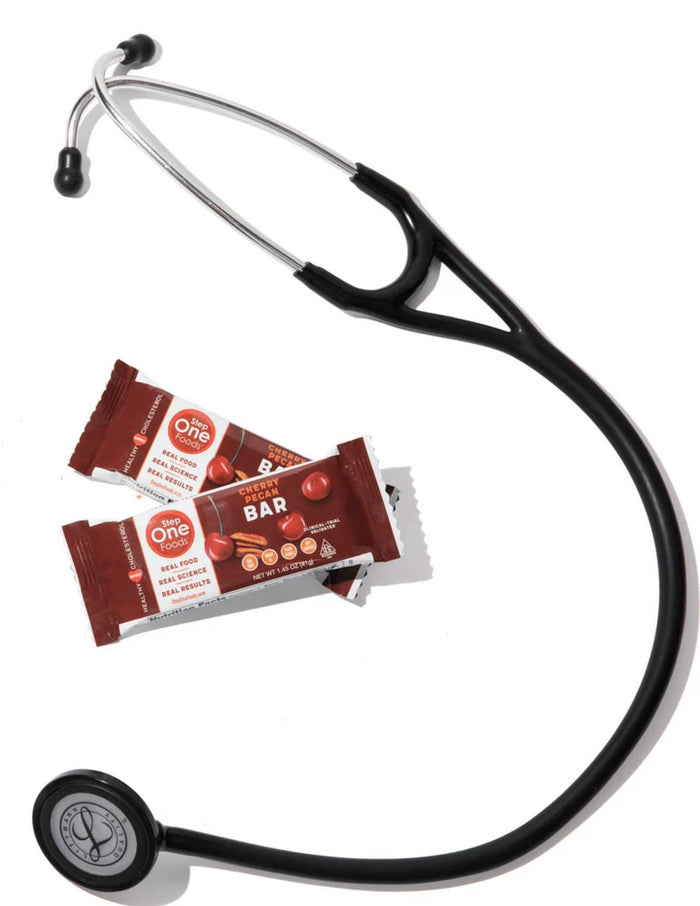
The easiest win is to remove sodium from a meal entirely rather than fighting it bite by bite. That's exactly how I designed Step One Foods: nine of our twelve products contain essentially no sodium at all (5 mg or less), so a breakfast or snack can add virtually none to your day, leaving your full allowance for everything else. For the bigger picture, see where all that sodium is coming from and how much sodium is too much.
If you're new to this site and found this useful, I write one of these evidence-based articles every week. You can get them in your inbox by joining my email list at the bottom of this page. No spam, no requirement to buy anything, just practical knowledge.


The Science Behind It
Tested & Proven Results.
- Cardiologist formulated
- Supported by over 500 publications
- Clinically-proven, in a double-blind randomized trial with Mayo Clinic and The University of Manitoba
80% of participants lowered their cholesterol in just 30 days. With just two servings per day, Step One Foods offers a proven-effective way to naturally lower LDL (bad) cholesterol.
Try Step One Foods Today!