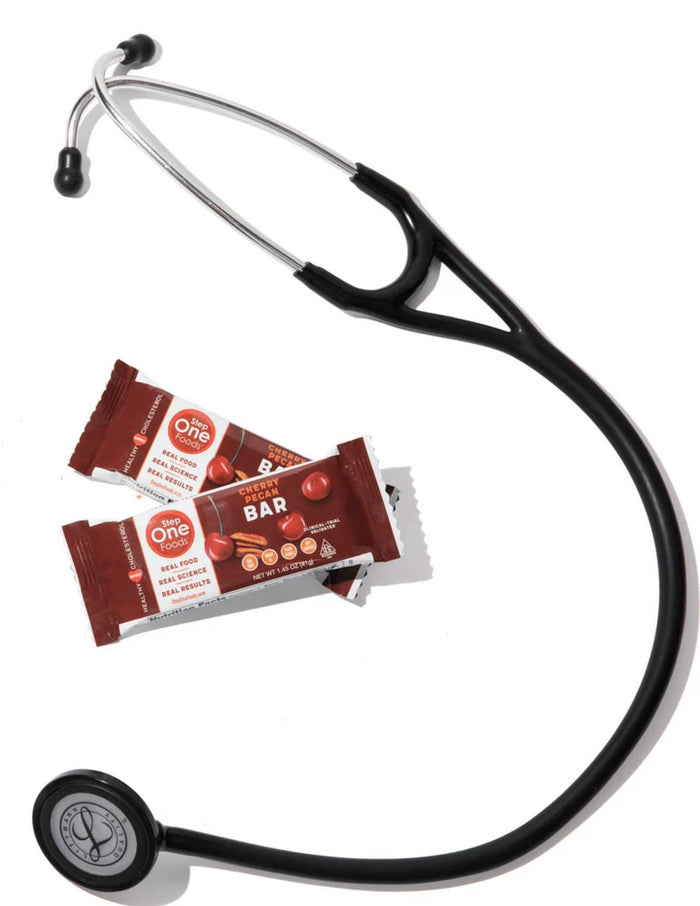
If you've been told your cholesterol is high, your first question is probably whether you can bring it down without medication. For most people, the answer is yes, at least to start, and often by a meaningful amount. Food and lifestyle are genuinely powerful here, powerful enough that in our own research, the right dietary changes lowered LDL as much as a starting dose of medication in some people. Here's a practical, evidence-based guide to what actually moves the number, roughly in order of impact.
Can you really lower cholesterol without medication?
For most people, yes. Diet and lifestyle can lower LDL substantially, and for someone with mildly to moderately elevated cholesterol and no established heart disease, this is exactly where to start. In our randomized controlled trial, conducted with Mayo Clinic and the University of Manitoba, the right foods lowered LDL in 80 percent of participants in 30 days, some by as much as a drug, with only a small dietary change.
There are limits worth being honest about. If your LDL starts very high, especially above 190, it could be genetically driven, and you may need medication no matter how well you eat. And if you already have heart disease, the target is low enough that most people need medication plus lifestyle, not lifestyle alone. But even then, how you eat determines how well those medications work, and often how little of them you need, and the right diet can even help reverse heart disease alongside medical care. Lifestyle is never wasted effort.
Add fiber, the most reliable food lever there is.
Soluble fiber is the single most dependable cholesterol-lowering food component, because of a neat biological trick. Your liver makes bile out of cholesterol to digest your meals, then normally reabsorbs and reuses it. Soluble fiber binds that bile and carries it out of the body, forcing your liver to pull LDL out of your bloodstream to make a fresh bile batch. The result is a lower LDL level, meal after meal. You'll find soluble fiber in oats, beans and lentils, barley, apples, citrus, and psyllium. Most Americans get nowhere near enough fiber, so this is usually the biggest opportunity on the list.
Add plant sterols, the quiet powerhouse.
Plant sterols are natural compounds in whole plant-based foods that are shaped just enough like cholesterol to compete for its absorption, so more cholesterol leaves the body instead of entering your bloodstream. Plant sterols work through a different door than fiber, which means the two together do more than either alone. Nuts, seeds, and their oils are the best natural sources.
Lean into unsaturated fats, and cut the saturated and trans fats.
The type of fat you eat affects your LDL more than the cholesterol you eat. Saturated fats, found in butter, cheese, fatty and processed meats, and coconut oil, raise LDL by slowing its clearance from your blood. Unsaturated fats, found in olive oil, nuts, seeds, avocado, and fatty fish, do the opposite. So the move is a swap, not just a subtraction: olive oil for butter, nuts for chips, fish or beans for red and processed meat. Trans fats, once the worst offenders, have largely been removed from the food supply, but check labels for anything "partially hydrogenated" and skip it.
Cut back on refined carbohydrates and sugar.
This is the one that surprises people most. Some of the worst cholesterol profiles I've seen were in people eating a low-fat, low-cholesterol, but highly processed, high-sugar diet. Here's why: refined carbohydrates and sugar are absorbed quickly, spiking blood sugar and then insulin, and insulin drives the liver enzyme that manufactures LDL. So white bread, white rice, cakes, cookies, candy, and sugar-sweetened drinks and juices can raise your LDL just as surely as a plate of bacon. Cutting them is often the fastest win of all.
Move your body most days.
Regular physical activity helps in several directions at once: it can nudge LDL down, raise protective HDL, lower triglycerides, and improve how your body handles blood sugar. It doesn't require a gym. A brisk daily walk, ideally working toward about 30 minutes on most days, does real good, and adding a short walk after meals helps with blood sugar too.
Lose a little weight if you're carrying extra.
You don't need a dramatic transformation. Even modest weight loss can improve LDL, HDL, and triglycerides together, especially when the weight comes off around the middle. And because the changes that lower cholesterol, more fiber, better fats, less sugar, more movement, also tend to support a healthy weight, this one often takes care of itself as you do the rest.
Don't smoke.
Smoking lowers your protective HDL and damages the lining of your arteries, making it easier for cholesterol to lodge there. Quitting is one of the highest-impact things you can do for your heart, and HDL begins to recover almost immediately after you stop.
What about specific foods like garlic and flaxseed?
Individual foods can help a little, but keep them in perspective. Garlic, for instance, appears to nudge cholesterol modestly in most studies, and it's a flavorful addition to a heart-healthy kitchen. Ground flaxseed has some of the most consistent single-food evidence going, since it delivers fiber, plant omega-3s, and lignans all at once. Just don't expect any single food to carry the load, the real work is done by an overall pattern rich in fiber, plant sterols, and healthy fats.
How much can all this lower your cholesterol, and how fast?
More than most people expect, and faster than most people expect. Cholesterol is one of the most responsive risk factors we treat: make the right changes and the number typically starts moving within a couple of weeks, with a meaningful drop by about a month, which you can confirm on a blood test at the two- to three-month mark. If you want the detail on timing, I've written a full post on how long it takes to lower cholesterol.
The reason food works so well isn't just the LDL drop. It's that the same changes lower blood pressure, steady blood sugar, calm inflammation, and support a healthy weight, all at once. A statin lowers one number. A better diet improves the whole picture.
Where to start
If the whole list feels like a lot, don't try to do it all at once. Pick the one or two changes you can actually sustain. Most people should start with adding fiber and cutting refined carbs, and build from there. Cholesterol responds fast, but it also drifts back fast if the old habits return, so the changes that matter are the ones you can keep. That's the entire idea behind Step One Foods: a small, sustainable daily change, built from whole foods clinically shown to lower LDL (in the Mayo Clinic and University of Manitoba trial), that fits into your life so you'll actually stick with it.
If you're new to this site and found this useful, I write one of these evidence-based articles every week. You can get them in your inbox by joining my email list at the bottom of this page. No spam, no requirement to buy anything, just practical knowledge.
The Science Behind It
Tested & Proven Results.
- Cardiologist formulated
- Supported by over 500 publications
- Clinically-proven, in a double-blind randomized trial with Mayo Clinic and The University of Manitoba
80% of participants lowered their cholesterol in just 30 days. With just two servings per day, Step One Foods offers a proven-effective way to naturally lower LDL (bad) cholesterol.
Try Step One Foods Today!