Updated July 2026
Back in 2015, the FDA sent KIND a warning letter telling the company to stop calling four of its bars "healthy," because they contained more saturated fat than the agency's rules allowed. The irony? That fat came mostly from nuts. The rule that flagged KIND would also disqualify salmon and avocados, while happily permitting fat-free chocolate pudding and some sugary cereals. The FDA eventually reversed course and let KIND use the word again. The whole saga is a perfect illustration of why you can't judge a food, especially a snack bar, by the front of the package or even by the nutrition panel. The ingredient list is where the truth lives. Here's how to read it like a cardiologist.
Why is the ingredient list more useful than the nutrition panel?
Because it's harder to game, and it tells you what a food actually is. The ingredient list is tightly regulated by the FDA: every ingredient must be listed, in descending order by weight, so the first few items tell you what you're really eating. The nutrition panel gives you numbers stripped of context, 12 grams of sugar looks the same whether it's from dates or corn syrup, but the ingredient list shows you the source. That said, manufacturers have learned to bend even this part of the label. Here are the four tricks I teach my patients to spot.
Tip #1: Watch for "sugar splitting"
Sugar splitting means dividing added sugar into several differently named forms so that no single one weighs enough to rank near the top of the list. Combined into one "sugar," it might land first; split into four or five aliases, it scatters quietly down the label. There are nearly 50 names for added sugar, and the average American consumes around 17 teaspoons of it a day, far above recommended limits.
Take a chewy granola bar that promises "no high fructose corn syrup." Read the list and you may find the sweetener split into brown rice syrup, dried cane syrup, cane syrup, honey, and molasses, five separate entries doing one job. Each stays low on the list individually; together they'd tell a very different story.
Tip #2: Not all fiber is created equal
The health benefits attributed to fiber come from research on naturally occurring fiber in whole foods, not isolated fiber added back into processed products. So when you see a bar boasting "9 grams of fiber," check where it comes from. Watch for inulin (also listed as chicory root, chicory root fiber, or chicory root extract), soluble corn fiber, and soluble wheat fiber. These extracted fibers are cheap, invisible in texture, and popular with manufacturers, but they can ferment quickly in the gut and cause bloating and discomfort, and they don't carry the same proven benefits as whole-food fiber – because they don’t come with whole food! A bar whose fiber comes mostly from added chicory root is not the same as one whose fiber comes from oats, nuts, and seeds.
Tip #3: Read the entire ingredient list, not just the highlight
Manufacturers love to trumpet one good ingredient while staying quiet about everything around it. Is that one virtue worth the rest of what's in the package? A bar marketed on "multi-health fiber" may also contain titanium dioxide, a whitening agent better known from paint and sunscreen, along with added sweeteners appearing under many names. A good rule: if you can't pronounce it or don't recognize it as food, think twice. Don't assume an ingredient is benign just because it's allowed in the package.
Tip #4: Look for the bait and switch
The front of the package might promise blueberries or strawberries; the ingredient list often reveals "flavored fruit pieces" instead, frequently made from apple, sugar, oil, and natural flavor, sometimes with no trace of the pictured fruit at all. A "strawberry" bar can turn out to contain strawberry-flavored cranberries and no strawberries. Once you start reading ingredient lists closely, you see this everywhere.
What does a clean bar look like?
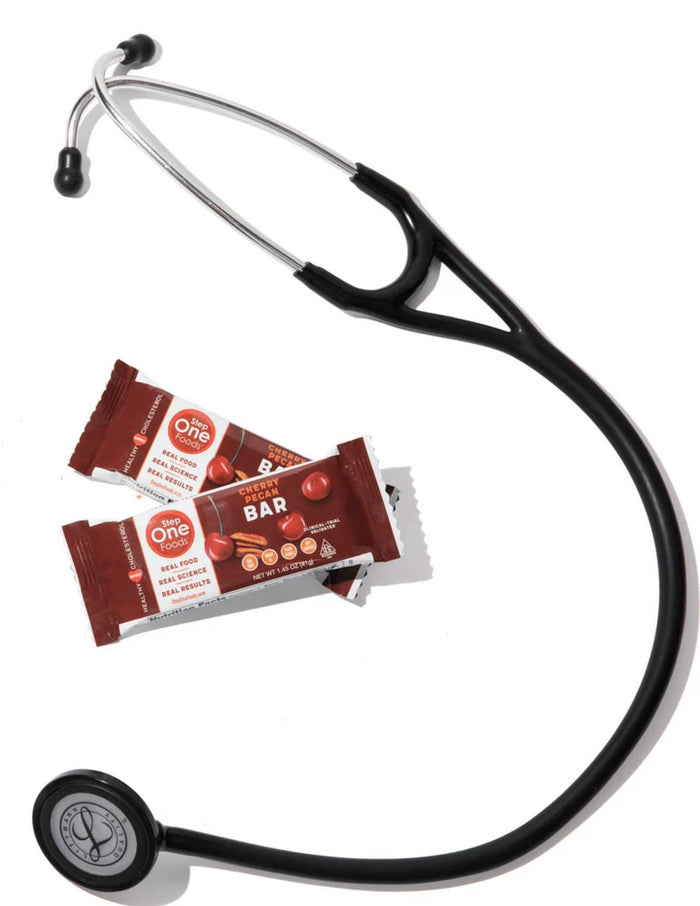
Short, recognizable, and honest, with no gap between the promise and the reality. At Step One Foods we believe in substance, not hype, so our ingredient lists are meant to be read. Because our foods are naturally low in sodium and high in whole-food fiber, omega-3 fatty acids, antioxidants, and plant sterols, our bars are an especially good choice for anyone managing high cholesterol, high blood pressure, or high blood sugar. The ingredient list for our Dark Chocolate Crunch bar reads like a pantry: bittersweet chocolate, almonds, whole pinto bean flour, chia seeds, oat bran, walnuts, dried cranberries, raisins, flax seed, plant sterols, and Saskatoon berries. No splitting, no combining, no bait and switch, because when the food is real, you don't need the tricks.
From a cardiologist's perspective, a food should be judged not by its marketing claims but by what it actually delivers. Learn to read the ingredient list, and you'll never be fooled by the front of the package again.
If you're new to this site and found this useful, I write one of these evidence-based articles every week. You can get them in your inbox by joining my email list at the bottom of this page. No spam, no requirement to buy anything, just practical knowledge.


The Science Behind It
Tested & Proven Results.
- Cardiologist formulated
- Supported by over 500 publications
- Clinically-proven, in a double-blind randomized trial with Mayo Clinic and The University of Manitoba
80% of participants lowered their cholesterol in just 30 days. With just two servings per day, Step One Foods offers a proven-effective way to naturally lower LDL (bad) cholesterol.
Try Step One Foods Today!