Updated July 2026
Statins like atorvastatin (Lipitor) and rosuvastatin (Crestor) are among the most prescribed medications in the world, and they save lives. But a lot of people would rather not take one, and I understand the instinct. The honest answer to whether you can try food first is that it depends on your personal risk, and for a meaningful number of people, a food-first trial is reasonable.
Food can make a measurable difference in as little as 30 to 90 days. So the real question is who can safely take a couple months to try, and who should be on a statin from day one. Here is how I think about it.
How do doctors decide who needs a statin?
Doctors start by sorting out your risk, and in 2026 the tools for doing that changed. The American College of Cardiology and the American Heart Association released new cholesterol guidelines that restored specific LDL goals and replaced the old risk calculator with a more accurate one called PREVENT. Broadly, the people who most need cholesterol-lowering treatment fall into four groups:
- Those with established heart or vascular disease, meaning a prior heart attack, stroke, stent, bypass, or artery problems elsewhere in the body.
- Those with diabetes.
- Those with very high LDL, generally 190 mg/dL or above.
- Those whose overall risk score comes back elevated.
Here is the encouraging part. The new PREVENT calculator is better calibrated than the one it replaced, and it actually flags fewer people for automatic statin therapy than the old tool did. Just as important, the 2026 guidelines are explicit that a healthy lifestyle is foundational, not optional, and that food and medication work best together rather than as rivals.
So when is it reasonable to try food first?
It depends on which of those four groups you fall into.
If you have established heart or vascular disease, you should be on a statin. Your risk of another event is high, so you want every tool working for you, and the evidence that statins lower that risk is vast and consistent. That does not mean food stops mattering. It means the answer is not one or the other, it is both, what I call a food-too approach. And if you cannot tolerate statins, the food part becomes absolutely critical.
If you have diabetes, you should generally be on a statin too, because your risk profile looks a lot like someone who already has heart disease. But food is critical here for another reason: it can improve, and sometimes even reverse, type 2 diabetes. If you and your doctor can get your diabetes into remission, you may be able to revisit whether you still need the cholesterol lowering drug.
If you have very high LDL without heart disease or diabetes, food is worth trying, with your doctor's involvement. Very high LDL, especially over 190, is often genetically driven, and the guidelines lean toward starting medication earlier in these cases. Even so, food can help, and I have seen people with very high starting numbers drop their LDL substantially with the right dietary changes. A food-first strategy may not lower your cholesterol enough to skip a statin entirely, but it can mean a lower dose.
If your only issue is an elevated risk score, this is where trying food first makes the most sense. The risk calculator leans heavily on age, so many older adults get flagged simply for having a birthday. Turning 60 should not automatically mean starting a lifelong medication. Use that score as a motivator, make real dietary and lifestyle changes, and work with your doctor on a prevention plan built around you.
How do I know if the food approach is working?
Treat it exactly as you would a medication. If you are using food to lower your cholesterol, follow up with blood tests to see whether it is working. If you make the right dietary changes, you can see meaningful LDL reductions in as little as 30 days. If the numbers move enough, you have your answer. If they do not, you and your doctor adjust the plan, which may include adding medication or modifying your diet further. Either way, you made the decision with data instead of guesswork.
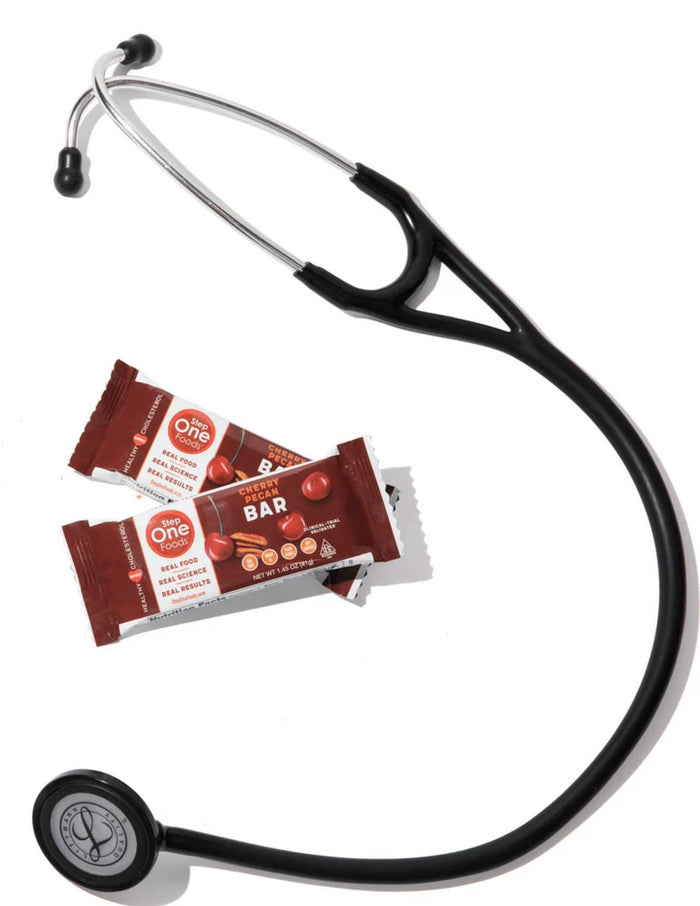
This is exactly why Step One Foods exists. We put meaningful doses of the fiber, phytosterols, and omega-3s shown to lower cholesterol into two simple servings a day, and we proved it works in as little as 30 days in a randomized controlled trial conducted with Mayo Clinic and the University of Manitoba. For someone cleared to try a food-first approach, it is a straightforward way to give that trial a real chance, and for someone already on a statin, it is a way to do everything possible alongside it.
Whatever group you are in, the goal is the same: the lowest risk you can achieve. For some people that means food. For many it means food and medication together. The one option that never makes sense is doing nothing.
If you're new to this site and found this useful, I write one of these evidence-based articles every week. You can get them in your inbox by joining my email list at the bottom of this page. No spam, no requirement to buy anything, just practical knowledge.

The Science Behind It
Tested & Proven Results.
- Cardiologist formulated
- Supported by over 500 publications
- Clinically-proven, in a double-blind randomized trial with Mayo Clinic and The University of Manitoba
80% of participants lowered their cholesterol in just 30 days. With just two servings per day, Step One Foods offers a proven-effective way to naturally lower LDL (bad) cholesterol.
Try Step One Foods Today!