Updated July 2026
Almost every weight-loss goal comes with an unspoken assumption: to lose weight, you have to eat less. I'd like to challenge that. The real key isn't eating less, it's eating more of the right things. Eat more fiber, more healthful fats, and more antioxidants, and the weight tends to take care of itself.
How can eating more help you lose weight?
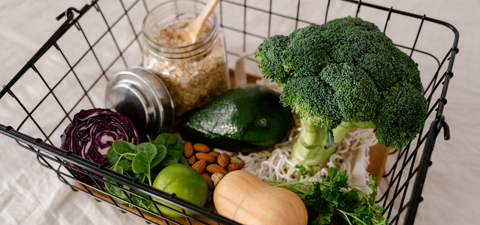
Because the right foods change the signals your body sends you. A diet built on beans and greens, nuts and seeds, fruits and vegetables, and whole grains lets you lose weight without ever counting a calorie or obsessing over portions. These foods are nutritionally dense but relatively calorie-poor, so they fill you up before they add up. Nuts and seeds are the exception, being both nutrient- and calorie-dense, but they deliver essential fatty acids and are so filling that it's hard to overdo them on a consistent basis. And when you supply your body with the nutrients it actually needs, it's far less likely to keep signaling you to eat.
Why does what you eat matter more than how much?
Because different foods send completely different signals, and those signals decide who's in charge. Try an experiment on yourself. One morning, eat a single plain bagel for breakfast, toasted if you like, nothing on it. Then pay attention over the next few hours: When do you start to feel sluggish? How soon does hunger come knocking? The next day, run it again, this time swapping in a bowl of oatmeal or a serving of Step One's whole-food pancakes. Notice the difference in how long you stay satisfied and how steady your energy feels. That contrast is the whole point. When you change the signals, you change the power structure: food no longer controls you, you control the food. And when food no longer controls you, weight takes care of itself.
What does this look like day to day?
Small, strategic swaps that quietly subtract calories while adding nutrition. Trading a plain bagel and an afternoon candy bar for a serving of oatmeal and a piece of fruit can cut roughly 180 calories a day, which works out to about 18 pounds over a year, with no calorie counting and no deprivation. This is also exactly why so many people report losing weight as a side benefit of Step One Foods without trying: eat for nutrient density and satiety, and the arithmetic sorts itself out on its own. It's also not the whole story on why the same calories affect two people differently, something I dig into in why two people can eat the same calories and only one gains weight.
If you're new to this site and found this useful, I write one of these evidence-based articles every week. You can get them in your inbox by joining my email list at the bottom of this page. No spam, no requirement to buy anything, just practical knowledge.


The Science Behind It
Tested & Proven Results.
- Cardiologist formulated
- Supported by over 500 publications
- Clinically-proven, in a double-blind randomized trial with Mayo Clinic and The University of Manitoba
80% of participants lowered their cholesterol in just 30 days. With just two servings per day, Step One Foods offers a proven-effective way to naturally lower LDL (bad) cholesterol.
Try Step One Foods Today!