Updated July 2026
The comedian Totie Fields once said she'd been on a diet for two weeks and all she'd lost was two weeks. If you've ever dieted, you probably feel that in your bones. I'll say plainly what I tell my patients: diets don't work. If they did, we wouldn't need a new one every January.
Why don't diets work?
Because they're built on deprivation, and deprivation always loses. I know this firsthand, not just from my patients. Over the years, to understand what people were actually putting themselves through, I tried a lot of them. The Banana Diet (lasted three days). The Grapefruit Diet (five days). The Cabbage Soup Diet (I nearly fainted on day four, and dealt with a lot of gas). "Eat Yourself Slim," the original glycemic-index plan. The Fat Flush Plan, which went fine until I got sick of the psyllium. I was a supportive companion through my husband's Atkins kick and I'm still not sure I can look at bacon the same way. South Beach.
Every one of them eventually got too boring or too restrictive, and that's exactly why they fail. They're radical departures from normal life, and they all end in a sense of deprivation. With deprivation comes want, and with want comes obsession. Nobody starts a diet planning to regain everything they lost and then some, but that's what happens the moment the diet ends.
Somewhere along the way we lost our healthy relationship with food. Food went from what it should be, a necessity and a pleasure, to something it should never be, an enemy and a punishment. We feel guilty when we enjoy something "bad," then try to punish ourselves back into balance through restriction. That's no way to live, and it's no way to get healthy.
Aren't our bodies just calories in, calories out?
No, and that's the flawed assumption underneath almost every diet. Your body is not a math problem to be solved by counting calories, points, or grams of carbs. It's an intricate system that runs on a diverse range of nutrients, and it responds to the quality of what you eat, not just the arithmetic. Research consistently shows that dieting drives a cycle of loss and regain, the yo-yo pattern that's hard on your metabolism and even harder on your mental health. Trying to be perfect is exhausting. And exhaustion is not sustainable, which is the one thing any real solution has to be.
Consider what the most restrictive popular diets actually ask. Strict keto holds you under about 20 grams of carbohydrate a day, less than what's in a single apple, while giving animal fat and protein a free pass, even though the Inuit, the one long-studied population eating that way, live on average about ten years less than their fellow Canadians. That should give anyone pause. If you want the specifics on individual plans, I've looked closely at several: whether low carb is really best for weight loss, the real disadvantages of keto, the dangers of the carnivore diet, and whether intermittent fasting lives up to its promise.
So if diets don't work, what does?
Eating for health instead of for weight. When you eat for health, the weight takes care of itself. It sounds almost too simple, but I've watched it play out for years: focus on getting healthy and the pounds quietly follow, without counting a single calorie, point, or carb gram, and without ever knowing your blood type. This is also the grain of truth in intuitive eating, though it only works once your instincts are guided by real food rather than hijacked by processed products.
The shift is less about taking bad things out than about putting good things in. Concentrate on adding foods that promote health, and you'll naturally crowd out the ones that promote disease, because there's only so much room in your stomach. Build your plate around real, whole, mostly plant-based foods, which are rich in the vitamins, minerals, fiber, and antioxidants that protect against chronic disease, and the rest sorts itself out. That's the entire philosophy, and it fits in a few words borrowed from the writer Michael Pollan: eat food, not too much, mostly plants.
Doing that also reconnects you to something dieting strips away, which is joy. Not the fleeting kind, but the deep kind: joy because you feel well, because you're mentally sharp, because you're not taking a fistful of medications, because you have energy to spare. Health ultimately comes from the interplay of what you eat, how you move, and how connected you are to other people. Diets isolate you from all three. Eating well quietly gives them back. It's no coincidence that this is exactly how the world's longest-lived people eat, as I explore in what the Blue Zones teach us about eating for a long life.
Where does Step One Foods fit in?
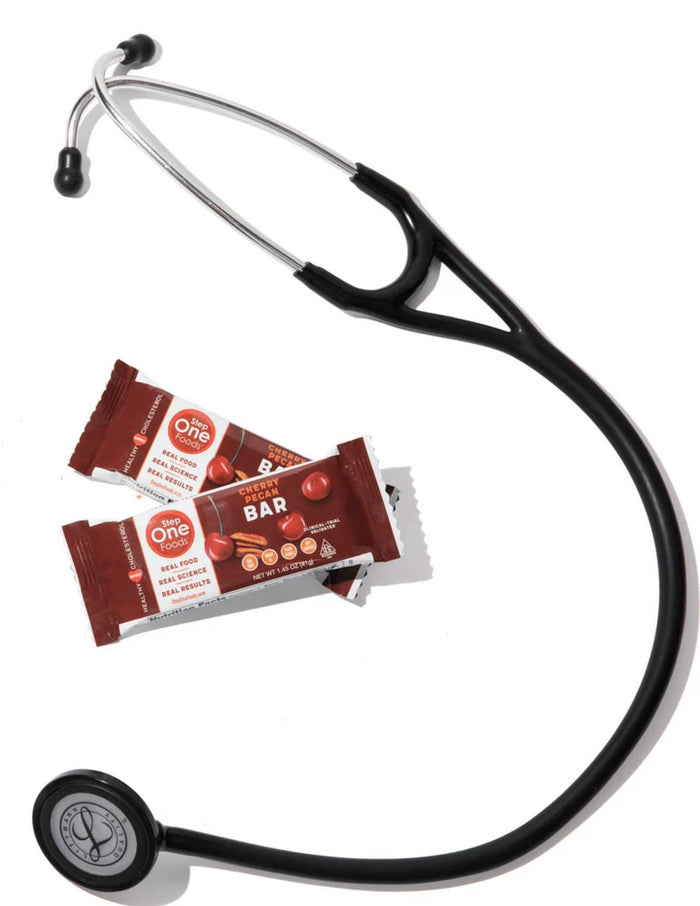
Step One was never designed as a diet. I created it to do one thing well: deliver specific, clinically meaningful levels of heart-protective nutrients from whole-food ingredients, in a form busy people can actually stick with. It's clinically proven to improve cholesterol, with LDL drops of 20, 30, even close to 40 percent in some people in about a month, as demonstrated in a randomized controlled trial conducted with Mayo Clinic and the University of Manitoba. Weight loss was never the goal, but many patients report it anyway, because when you eat to lower cholesterol you're also eating in a way that's nutritionally dense and satisfying, which means fewer cravings and lower overall food intake without trying. It's not a complete eating program and it doesn't pretend to be. It's a reliable way to get the food part right twice a day so you can stop dieting and spend your energy on the things that actually bring you joy.
So skip the plan to start a diet. Make a better plan instead: never diet again.
If you're new to this site and found this useful, I write one of these evidence-based articles every week. You can get them in your inbox by joining my email list at the bottom of this page. No spam, no requirement to buy anything, just practical knowledge.


From Dr. KlodasFood, but with a
Try Step One Foods Today
Food, but with a
medical degree.
I built Step One Foods for my patients. Two servings a day replace the breakfast and snack you already eat.
Tested in a double-blind, randomized crossover trial conducted at Mayo Clinic and the University of Manitoba, 80% of participants lowered their LDL in 30 days.
Your first order is backed by our money-back guarantee.