Updated July 2026
A few years back, the snack-bar aisle turned into a boxing ring. Clif Bar published an open letter in the New York Times challenging KIND, Larabar, and RxBar to switch to organic ingredients. KIND fired back, calling out competitors for high sugar content and for using deceptive ingredient lists that split added sweeteners. It made for entertaining marketing. It did almost nothing to help anyone actually eat better. Honestly, it's exactly this kind of nonsense that made me start Step One Foods.
Who was right in the Clif vs. KIND fight?
Both had a point, and both were being selective. KIND noted that a classic Clif Bar is about 31% sugar by weight and an RxBar about 25%, while a KIND bar is only around 13%. Fair enough. But KIND was carefully choosing which comparisons to make. Its own Mango Apple Chia bar, marketed on having just three ingredients, is roughly 60% sugar by weight, far more than the competitors it was criticizing. (Ironically, that's still one of KIND's better bars, because the sugar comes from actual whole fruit.) And KIND calling out ingredient splitting is a little rich when plenty of its own products list sugar, glucose syrup, and honey as separate entries.
Meanwhile, Clif's big selling point, organic ingredients, doesn't hold up the way it sounds either.
Does organic sugar make a bar healthier?
No. The brown rice syrup in a Clif Bar is an added sweetener whether it's organic or not, and your body handles it the same way. "Organic" describes how an ingredient was farmed, not whether it belongs in a food you're eating for health. Organic cane sugar is still sugar. This is one of the most common ways "better-for-you" marketing misleads people: it swaps one virtuous-sounding label for actual nutritional quality.
Why doesn't the sugar number tell the whole story?
Because nutrition panels miss most of what a food actually does inside you. Focusing on a single macronutrient like sugar can be deeply misleading. The classic illustration: the nutrition panels for an apple and a few gummy bears can look remarkably similar, including the sugar, yet nobody would claim they do the same thing to your body. Sugar content, added or natural, is only one line in a much longer story.
What about the fiber in these bars?
It's often not the kind you want. The bulk of the fiber in many KIND bars comes from inulin, an inexpensive short-chain fiber extracted from chicory root. It may be natural and it may count toward the fiber number on the label, but the research showing fiber's health benefits is based on fiber eaten as part of whole foods, not extracted and added back in. Inulin also ferments readily in the gut, so some people can't tolerate it without bloating and discomfort. At Step One Foods, we know the source of the fiber matters as much as the amount, which is why you'll never see inulin in our products. (For the full playbook on decoding these labels, see my cardiologist's guide to reading a snack bar.)
So which bar should you buy?
The one whose ingredient list you can actually stand behind, not the one that won the marketing spat. These tit-for-tat accusations don't help consumers; they just add noise to an already confusing food landscape. What matters in the end is the health result of eating something, and not one of these brands - not Clif, not KIND, not RxBar, or Larabar - can point to a single study using their product that showed a measurable health improvement.
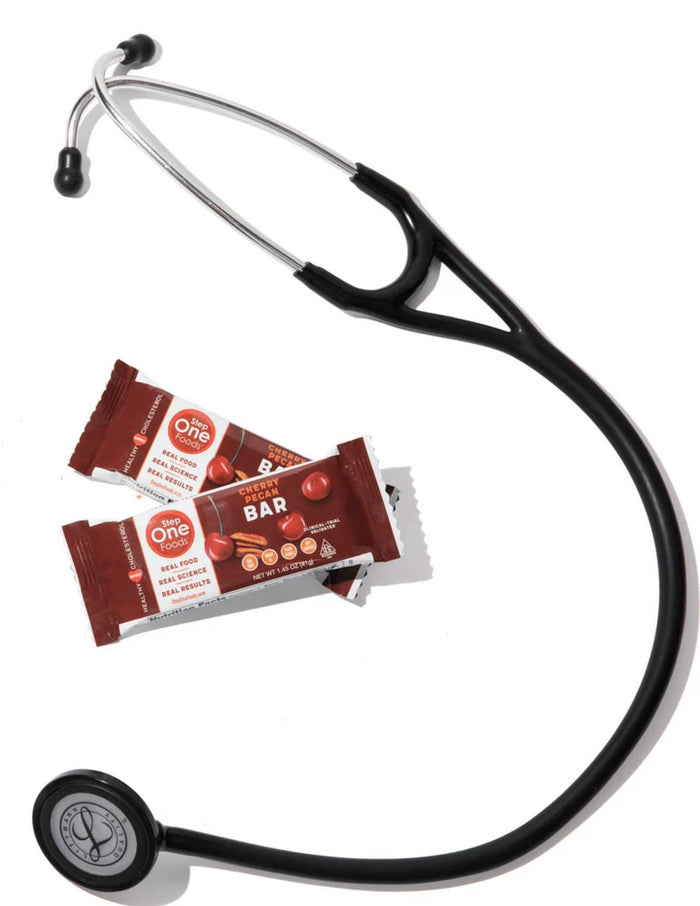
That's the gap we set out to fill. Step One Foods exists because someone needed to rise above the hype and focus on real science and proven results rather than product buzz. Substance matters. Because your health depends on it.
If you're new to this site and found this useful, I write one of these evidence-based articles every week. You can get them in your inbox by joining my email list at the bottom of this page. No spam, no requirement to buy anything, just practical knowledge.


The Science Behind It
Tested & Proven Results.
- Cardiologist formulated
- Supported by over 500 publications
- Clinically-proven, in a double-blind randomized trial with Mayo Clinic and The University of Manitoba
80% of participants lowered their cholesterol in just 30 days. With just two servings per day, Step One Foods offers a proven-effective way to naturally lower LDL (bad) cholesterol.
Try Step One Foods Today!