

Few ideas in cardiology have stirred up as much hope as inflammation. Touted as an important risk factor for developing heart disease, screening for inflammation has entered mainstream cardiology care. This month, the American College of Cardiology even made it the cover story of its member magazine, under the headline "Inflammation as a Treatable Target."
Days later, the full results of a study evaluating one of the most anticipated anti-inflammatory heart drugs in years were released. The drug was no better than a placebo.
So what gives? Turns out the relationship between inflammation and heart disease is more complex than initially supposed. And sitting in the middle of it all is a simple blood test called C-reactive protein, or CRP.
What is CRP?
CRP is a marker of inflammation and the end product of a cascade of events.
When plaque builds up in arteries, it disrupts the underlying architecture of blood vessel walls and creates tissue damage. That process activates white blood cells which are designed to deal with various threats such as infection and tissue damage from any cause. Activated white blood cells, in turn, release various substances, including interleukin-6, stimulating the liver to produce CRP as well as proteins involved in blood clotting. CRP then enters the bloodstream, ready to bind to dead or dying cells and certain bacteria, setting the stage for their removal.
Because CRP travels in the blood, we can measure it. The measurement version used to assess heart risk is called high-sensitivity CRP, or hs-CRP. An hs-CRP level is merely a CRP measurement with better discrimination at lower circulating CRP levels. Under 1 mg/L signals lower risk. Between 1 and 3 mg/L is average. Above 3 mg/L signals higher risk - especially for out-of-the blue events like heart attacks and strokes.
Where is CRP Useful?
The value of the test is that it measures something cholesterol doesn't. As far back as 1997, the Physicians' Health Study showed that a higher CRP levels predicted cardiovascular events in apparently healthy people, independent of their cholesterol.
The evidence has grown since. In the Women's Health Study, CRP predicted future events over 30 years better than LDL cholesterol did, and an analysis of close to 500,000 people in the UK found the same thing.
The most convincing test came from the JUPITER trial. It enrolled more than 17,000 people whose LDL was not considered high at the time, but whose CRP was in the upper half of the population. None of them would have qualified for a statin under the guidelines of the day. On a statin, they had 44% fewer major cardiovascular events, 63% fewer heart attacks, and 20% fewer deaths from any cause.
CRP testing may actually be most useful in people who otherwise look healthy. About 8,000 people in JUPITER had none of the standard risk factors doctors usually look for, but did have an elevated CRP. The statin cut their rate of cardiovascular events by about one-third.
The JUPITER results are a big part of why the American College of Cardiology's 2025 scientific statement on inflammation endorses broad hs-CRP screening. Its authors concluded that the time for taking action had arrived... the action being to prescribe more statins.
Where Does CRP Fall Short?
In many ways, CRP is a bit like a fever. An elevated reading tells you the body is fighting something. It just doesn't tell you what.
CRP also isn't specific to the heart or plaque deposition. An infection or an injury anywhere can push it up. So one abnormal test is not necessarily helpful, especially if the level is above 10 mg/L, which usually means something outside of the cardiovascular system is muddying the result. What’s more worrisome is a CRP that comes back elevated again and again and again when all other risk markers have been addressed.
You would think that lowering CRP in that scenario would be a good thing. You'd be wrong.
A drug called ziltivekimab, which blocks interleukin-6 (the messenger that tells the liver to make CRP), made by Novo Nordisk (the folks that brought us Ozempic), was tested in some 6000 people with severe heart disease, advanced kidney disease, and elevated inflammatory markers. The drug did lower inflammation, dropping IL-6 by 76% and CRP by 64%. But those taking it did NO better than those taking a placebo, and that held true in every subgroup of patients.
Researchers are now debating why. The patients may have had disease too advanced to help. The drug may have hit the wrong target. Or inflammation may be more a sign of heart disease than a cause of it. Just like grey hair is a sign of aging, not the reason another birthday has passed.
That last possibility is one I've believed for a long time. Elevated CRP is a symptom, the body's response to plaque, not the cause of why plaque accumulated in the first place. Lowering the response doesn't remove what it's responding to.
This is my conclusion, because that's what makes sense to me. But the question isn't settled. A different protein in the same pathway may turn out to be a better target, or ziltivekimab may be more impactful in people who have just had a heart attack (this is still being tested). Or perhaps renaming the drug to something more pronounceable will help it work better (had to put that in - who names these drugs anyway?)
But for now, and on a more serious note, achieving a lower CRP on a lab report does not appear to be a goal in and of itself.
What to Do for Elevated CRP?
Apparently, when it comes to CRP, everything old is new again.
Colchicine is a drug that's been around for ever and long used primarily to treat gout. But in two trials colchicine lowered rates of subsequent heart attack and stroke in people with established heart disease by roughly 25%. As a result, low-dose colchicine is the first anti-inflammatory drug the FDA has cleared to reduce cardiovascular events.
However, it is still rarely prescribed for this purpose. Part of the reason is that it's an old, cheap generic drug with no one marketing it. Its impact on CRP is also not consistent, so whether an elevated CRP should be the signal to use it is not completely clear. If you're wondering whether colchicine is right for you, ask your cardiologist.
And remember, statins lower both CRP and LDL cholesterol, which is likely what made the JUPITER results so striking and what might make the addition of a fancy drug to someone on statins already far less impactful on outcome.
And never forget all the things you can do to lower inflammation in your body without ever reaching for a prescription bottle! A whole food, plant centric diet, exercise, and quitting smoking all reduce inflammatory load. So does losing weight, because visceral fat, the fat packed deep around your organs, is a hotbed of inflammation. For the specific foods that fuel inflammation and the ones that help calm it, see my post on inflammation and heart risk.
I created Step One Foods to help people lower their LDL with food, and that's what our clinical trial showed. Our trial was not designed to evaluate CRP so I can’t give you any specifics there. What I CAN tell you is that every ingredient in every product was chosen for its health promoting properties, including its antioxidant contribution, the food property most important for helping quell inflammation.
An elevated CRP is a clue, not a verdict. And if the clue is pointing to a less than perfect diet, Step One Foods is here to help.
If you're new to this site and found this useful, I write one of these evidence-based articles every week. You can get them in your inbox by joining my email list at the bottom of this page. No spam, no requirement to buy anything, just practical knowledge.
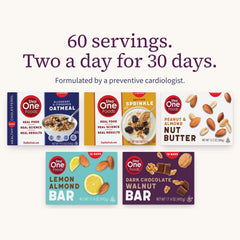
30-Day Protocol Pack



From Dr. KlodasFood, but with a
Try Step One Foods Today
Food, but with a
medical degree.™
I built Step One Foods for my patients. Two servings a day replace the breakfast and snack you already eat.
Tested in a double-blind, randomized crossover trial conducted by researchers at Mayo Clinic and the University of Manitoba, 80% of participants lowered their LDL in 30 days.
Your first order is backed by our money-back guarantee.