
I am 54 and post menopausal. Menopause has sent my already high cholesterol even higher. I am not in bad health and moderately active. I have tried every supplement out there over the years to try and lower my cholesterol with no results. I was skeptical about Step One Foods, but after reading the reviews and seeing the money back guarantee, I thought, let's try it. My total cholesterol started at 278 in September 2024 and is now at 235.
Cholesterol · Supplements
Do Cholesterol Supplements Work? An Honest Review of Fish Oil, Red Yeast Rice and More
Eleven of the most-bought supplements, what the trials found, and which three are worth the money.
- Cardiologist-created
- Studied at Mayo Clinic
- Every claim sourced

The cholesterol supplement aisle is large, expensive, and mostly disappointing. This page goes through it honestly, and several sections amount to advice to stop buying something.
One piece of context first, because it explains a lot of what follows.
Red yeast rice: it works, and that is the problem
Red yeast rice does lower LDL cholesterol. Across 14 double-blind trials running 4 to 24 weeks, extract lowered LDL by a mean of 35.82 mg/dL, which is a larger effect than anything else in this article.
The reason it works is the part most buyers do not know. Its active compound, monacolin K, is structurally identical to lovastatin, a prescription statin. Anyone taking red yeast rice specifically to avoid taking a statin is taking a statin.
The European Union responded by restricting monacolins from red yeast rice to under 3 mg per daily portion, with mandatory warnings. In the US, NCCIH describes FDA's position as being that red yeast rice products with enhanced or added lovastatin cannot be marketed as dietary supplements.
If a prescription statin is the right treatment for you, a prescription statin is safer than an unregulated one, because the dose is known and someone is monitoring you. That is the honest conclusion here, and it points toward your doctor rather than away from medication.
Fish oil: a triglyceride supplement, sold as a cholesterol one
Omega-3 supplements are among the most purchased products in this category, and their effect on LDL is not what buyers assume.
EPA and DHA behave differently. Pooled against placebo, DHA raised LDL cholesterol by 7.23 mg/dL, while EPA produced a small non-significant reduction.
The American Heart Association notes that at prescription doses of 4 grams a day, EPA and DHA formulations lower triglycerides by 20 to 30 percent while raising LDL, whereas EPA-only formulations do not raise LDL.
The two big outcome trials disagreed
REDUCE-IT tested 4 grams a day of EPA-only icosapent ethyl in 8,179 statin-treated patients and found major cardiovascular events reduced from 22.0 percent to 17.2 percent. STRENGTH tested an EPA plus DHA formulation against corn oil in 13,078 similar patients and found nothing: 12.0 percent against 12.2 percent.
A biomarker substudy complicated REDUCE-IT further. Its comparator was mineral oil, and the mineral oil arm showed increases from baseline of about 22 percent in hsCRP and 29 percent in interleukin-1 beta, raising the question of whether part of the apparent benefit came from harm in the comparison group.
For ordinary over-the-counter doses, VITAL tested 1 gram a day of marine omega-3 in 25,871 US adults and found no significant reduction in major cardiovascular events.
Eating fish remains a good idea. Buying fish oil capsules to lower LDL cholesterol is buying the wrong product for the job.
The ones that failed in good trials
Niacin
Niacin at pharmacologic doses genuinely improves the lipid panel: HDL up 10 to 30 percent, LDL down 10 to 25 percent, triglycerides down 20 to 50 percent. It was used for decades on that basis.
Then the outcome trials arrived. A Cochrane review of 23 trials in 39,195 people found no reduction in deaths, cardiovascular deaths, heart attacks or strokes.
HPS2-THRIVE, the largest, found major vascular events at 13.2 percent against 13.7 percent, along with an increase in serious adverse events. Niacin is the clearest illustration in this whole field that a better lipid panel is not the same as a better outcome.
Garlic
A six-month randomized trial compared raw garlic, a powdered supplement and aged garlic extract against placebo in 192 adults. LDL changes were +0.4, +3.2 and +0.2 mg/dL respectively, while placebo fell 3.9. None of it worked.
Policosanol
Trials from a single research group reported LDL reductions of 20 to 30 percent. An independent randomized trial of 143 patients found no lipid reduction beyond placebo at either usual or high doses. When one group produces a large effect that nobody else can reproduce, the independent result is the one to trust.
Guggulipid
In a randomized trial, LDL fell 5 percent on placebo and rose 4 to 5 percent on guggulipid, a net difference of roughly 9 to 10 percent in the wrong direction.
CoQ10
For LDL, CoQ10's pooled effect across 50 randomized trials was a reduction of 3.03 mg/dL, which is statistically detectable and clinically negligible.
Its more common use is for statin-associated muscle symptoms, where the evidence genuinely conflicts: meta-analyses have reached opposite conclusions, one finding no benefit over placebo and a more recent one finding significant pain reduction. That question is open.
The three worth considering
Psyllium fiber
This one earns its place. Across 28 randomized trials in 1,924 people, about 10 grams a day lowered LDL cholesterol by 0.33 mmol/L, with moderate-quality evidence for LDL and high-quality evidence for apoB. Roughly three rounded teaspoons of husk in water, daily. It is cheap and it works. Most people stop because of the texture.
Plant sterols and stanols
The best-characterized dose-response of any food-based lever: LDL reductions of 6 to 12 percent across intakes of 0.6 to 3.3 grams a day, pooled across 124 studies, with the effect plateauing around 3 grams.
There is a catch specific to the supplement aisle, covered in the next section.
Berberine and artichoke leaf, with reservations
Berberine showed an LDL reduction of 0.38 mmol/L across 16 trials, but the meta-analysis authors judged the underlying trials to be at high risk of bias.
Artichoke leaf extract showed a 14.9 mg/dL reduction across nine trials in 702 people, which is a small evidence base. Both are plausible and neither is settled. Treat the effect sizes as provisional.
Why sterols underperform in a capsule
Plant sterols are the strongest food-based lever available, and they are sold in pill form, so this deserves its own section.
Pooled across eight clinical trials, plant sterol and stanol supplements in capsule or tablet form at 1 to 3 grams a day lowered LDL cholesterol by 12 mg/dL. That is a real effect and it is smaller than the figures usually quoted for sterols, which come from trials delivering them in food.
The mechanism explains it. Sterols work by competing with cholesterol for absorption in the gut, which requires them to be present, dispersed, at a meal. FDA's own authorized health claim for plant sterols reflects this: it specifies the daily amount consumed in two servings, at different times of day, with other foods.
A capsule taken on its own schedule is fighting the mechanism.
Which is the argument for putting the dose where it works. See what two servings a day delivers
What a cardiologist tells patients about this aisle
Elizabeth Klodas has had the supplement conversation with a lot of patients, usually after they have spent several hundred dollars. The pattern repeats: something with real pharmacology sold without a known dose, or something with no pharmacology sold with excellent marketing.
The compounds that work are known, and they are the same four that keep appearing across this whole subject: soluble fiber, plant sterols, omega-3s and antioxidants. Getting them at the amounts that were studied is the entire challenge, and a capsule turns out to be a poor delivery vehicle for the most important one.
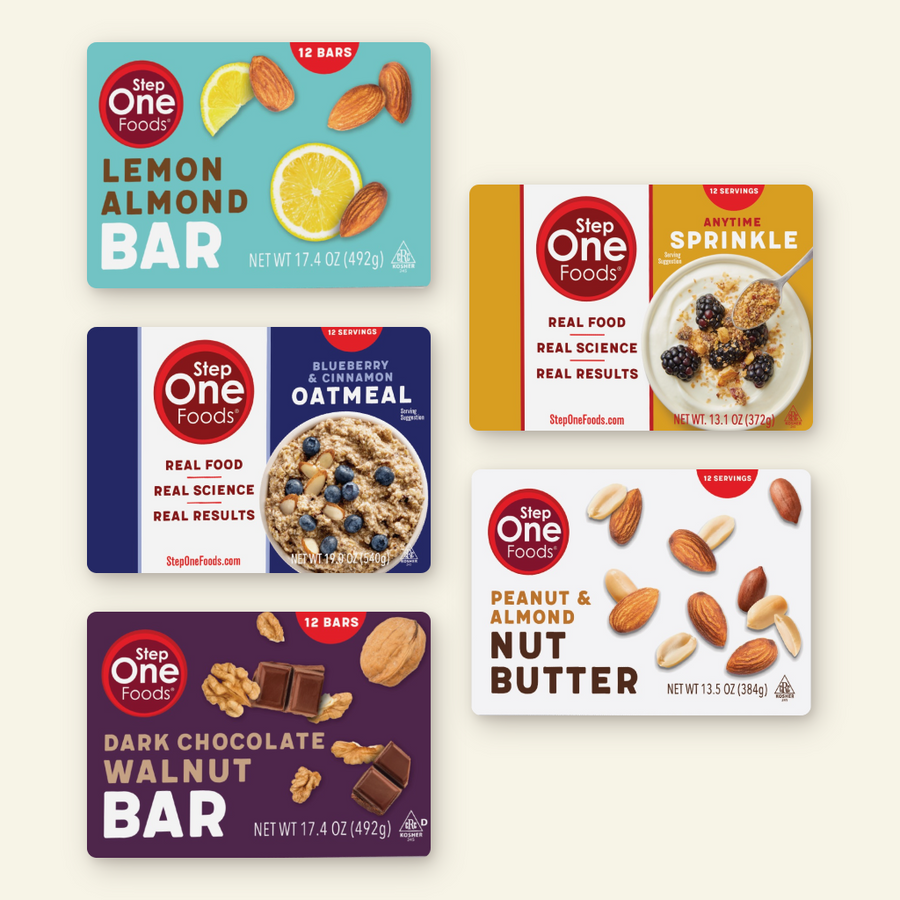
So Step One Foods puts them into food. In the published trial each serving delivered at least 5 grams of fiber, 1,000 milligrams of omega-3 fatty acids, 1,000 milligrams of plant sterols and 1,800 micromoles of antioxidants, taken twice a day with meals, which is how sterols are supposed to be taken.
“The doses that lower cholesterol do not fit in a capsule. They fit in food, eaten twice a day, which is also when they work best.”
Elizabeth Klodas, MD, FACC · Board-certified cardiologist
Cohen PA, et al. Eur J Prev Cardiol, 2017 (28 brands); Gardner CD, et al. Arch Intern Med, 2007 (n=192); J Acad Nutr Diet, 2013 (8 trials); Kopecky SL, et al. The Journal of Nutrition, 2022.
Real food. Real science. Real results.
The four compounds with real evidence, at the amounts used in the trial, delivered the way plant sterols are supposed to be taken.

“I have tried every supplement out there over the years to try and lower my cholesterol with no results.”
The 30-Day Starter Pack
Soluble fiber, plant sterols, omega-3 ALA and antioxidants in food you eat at meals, which is where sterols work best.
- 2 g of plant sterols a day across two servings, taken with food
- Twelve products across bars, oatmeal, smoothie mix, nut butter and sprinkles
- Free shipping over $99
- 30-day money-back guarantee
People who tried the aisle first
I have had high cholesterol for years thanks to family genetics. I tried four different statins only to have the same side effects, muscle pain. Diet and exercise along with a multitude of different supplements never changed my results. I did see the advertisement for Step One and the claim that it helps to lower cholesterol. Of course I was skeptical, but I had nothing to lose. I tried the program for 30 days. My total cholesterol went from 290 to 199 and the LDL went from 183 to 114.
January 2022 my doctor suggested I start a statin. Along with diet and exercise, I began taking Cholesoff and redid labs 3 months later. My results: total cholesterol 225 increased to 234; triglycerides 99 increased to 155; LDL decreased from 137 to 128. I was disappointed with the increased numbers. This was in May 2022 and the same month I had seen an ad for Step One Foods. I ordered the starter kit and began June 30, 2022.
Sources
- NIH National Center for Complementary and Integrative Health. Red Yeast Rice.
- Cohen PA, Avula B, Khan IA. Variability in strength of red yeast rice supplements purchased from mainstream retailers. Eur J Prev Cardiol, 2017.
- Commission Regulation (EU) 2022/860 — monacolins from red yeast rice in food supplements.
- Investigation of puberulic acid in the 2024 Japanese beni-koji red yeast rice incident. Mutagenesis, 2025.
- Nationwide nephrologist survey of kidney injury associated with recalled beni-koji red yeast rice products. Kidney Int, 2025.
- Trogkanis E, et al. Red yeast rice extract and lipid outcomes: systematic review and meta-analysis of double-blind trials. Nutrients, 2024.
- Wei Y, et al. Differential effects of EPA and DHA on LDL cholesterol: a meta-analysis. Curr Atheroscler Rep, 2011.
- Skulas-Ray AC, et al. Omega-3 Fatty Acids for the Management of Hypertriglyceridemia: a Science Advisory From the American Heart Association. Circulation, 2019.
- Bhatt DL, et al. Cardiovascular Risk Reduction with Icosapent Ethyl for Hypertriglyceridemia (REDUCE-IT). N Engl J Med, 2019.
- Nicholls SJ, et al. Effect of High-Dose Omega-3 Fatty Acids vs Corn Oil on Major Adverse Cardiovascular Events (STRENGTH). JAMA, 2020.
- Ridker PM, et al. Effects of Randomized Treatment With Icosapent Ethyl and a Mineral Oil Comparator on Biomarkers. Circulation, 2022.
- Manson JE, et al. Marine n−3 Fatty Acids and Prevention of Cardiovascular Disease and Cancer (VITAL). N Engl J Med, 2019.
- Gencer B, et al. Effect of Long-Term Marine Omega-3 Fatty Acids Supplementation on the Risk of Atrial Fibrillation. Circulation, 2021.
- Meta-analysis of coenzyme Q10 supplementation and lipid profiles. J Clin Endocrinol Metab, 2022.
- Kennedy C, et al. Coenzyme Q10 for statin-associated muscle symptoms: a systematic review and meta-analysis. Atherosclerosis, 2020.
- NIH Office of Dietary Supplements. Niacin: Fact Sheet for Health Professionals.
- Schandelmaier S, et al. Niacin for primary and secondary prevention of cardiovascular events. Cochrane Database of Systematic Reviews, 2017.
- HPS2-THRIVE Collaborative Group. Effects of Extended-Release Niacin with Laropiprant in High-Risk Patients. N Engl J Med, 2014.
- Gardner CD, et al. Effect of raw garlic vs commercial garlic supplements on plasma lipid concentrations in adults with moderate hypercholesterolemia. Arch Intern Med, 2007.
- Meta-analysis of berberine supplementation and lipid outcomes. Phytomedicine, 2019.
- Berthold HK, et al. Effect of policosanol on lipid levels among patients with hypercholesterolemia or combined hyperlipidemia: a randomized controlled trial. JAMA, 2006.
- Szapary PO, et al. Guggulipid for the treatment of hypercholesterolemia: a randomized controlled trial. JAMA, 2003.
- Meta-analysis of artichoke leaf extract and blood lipids. Crit Rev Food Sci Nutr, 2018.
- Jovanovski E, et al. Effect of psyllium fibre on LDL cholesterol, non-HDL cholesterol and apoB. Am J Clin Nutr, 2018.
- Ras RT, Geleijnse JM, Trautwein EA. LDL-cholesterol-lowering effect of plant sterols and stanols across different dose ranges. Br J Nutr, 2014.
- Meta-analysis of plant sterol/stanol supplements in capsule or tablet form. J Acad Nutr Diet, 2013.
- US FDA. Structure/Function Claims (Dietary Supplement Health and Education Act, 1994).
- Tucker J, et al. Unapproved Pharmaceutical Ingredients Included in Dietary Supplements Associated With US FDA Warnings. JAMA Netw Open, 2018.
- Kopecky SL, Alias S, Klodas E, Jones PJH. Reduction in serum LDL cholesterol using a nutrient compendium in hyperlipidemic adults unable or unwilling to use statin therapy. J Nutr, 2022.
- Cardiologist-created
- Studied at Mayo Clinic
- Real food, not supplements
Step One Foods is food, not medication, and it is not a substitute for treatment your physician has recommended. If a statin is needed, a statin should be taken. Tell your doctor about any supplement you are taking, particularly red yeast rice, because it contains a compound identical to a prescription statin.
Effect sizes above are from the published trials and regulatory documents linked in the sources list. Individual results vary.
