Before you go — get the Cholesterol Lowering Guide
A cardiologist's plain English breakdown of what causes high cholesterol, the various treatments available, and the foods and supplements that can help.
No spam. Unsubscribe anytime.
You're all set!
Your Cholesterol Lowering Guide is confirmed — it'll be in your inbox in the next few minutes.
Cholesterol · Oats
Does Oatmeal Lower Cholesterol? What It Does, and Where It Falls Short
Oats work. The catch is the amount, and the number on the box could be a quarter of the dose the research is built on.
Medically reviewed by Elizabeth Klodas, MD, FACC
Board-certified cardiologist · Founder, Step One Foods
Published July 2026·8 min read
Cardiologist-created
Studied at Mayo Clinic
FDA and EFSA thresholds cited
A bowl of oatmeal is a real intervention. When the formulation is correct.
Oatmeal has the best reputation of any food on the cholesterol shelf, and most of it is deserved.
The soluble fiber in oats, beta-glucan, binds bile acids in your gut, preventing their reabsorption. That forces your liver to pull cholesterol out of circulation to make more bile acids for the next meal. That mechanism is well described and the trials back it up.
Where this goes wrong is the serving size. Almost everyone eating oatmeal for their cholesterol is eating between a quarter and a half of the amount that was studied, but has no way of knowing it from the packaging.
How much oatmeal is 3 grams of beta-glucan?
This is the part no box will tell you, so here is the arithmetic from FDA's own numbers. The agency's standard serving of plain dry hot cereal is 40 grams, and rolled oats must be at least 4 percent beta-glucan by dry weight to qualify for the oat health claim.
Working from the regulation and from manufacturers' own labels:
Steel-cut, rolled or old-fashioned oats: 40 to 44 g at the 4 percent minimum gives 1.6 to 1.8 g. Reaching 3 g takes almost two servings, about 75 g of dry oats a day, close to two cups cooked.
Instant packets: a 28 g packet carries about 1 g of beta-glucan. That is roughly three packets a day, every day.
Puffed oat cereals: 1 cup of Honey Nut Cheerios lands at 0.75 g. Which means 4 servings a day, for a total of 560 calories.
Oat bran: the most concentrated option. About 55 g of dry oat bran reaches the full 3 g, roughly one and a half standard servings.
Soluble fiber and beta-glucan are not the same number
Nutrition labels report soluble fiber. Every meta-analysis and the FDA claim are all about beta-glucan specifically. FDA's own 1997 rule states that roughly 87 percent or more of the soluble fiber in whole oats is beta-glucan.
So a serving declaring 2 grams of soluble fiber is supplying about 1.74 grams of beta-glucan. The label is slightly generous against the thing that was tested. Small gap, but it runs in the direction of making you think you have arrived when you have not.
The claim on the box is one quarter of a dose
This one is worth sitting with. FDA lets a food carry the oat heart-disease claim if a serving supplies 0.75 grams of beta-glucan. That threshold was not chosen because 0.75 grams does anything.
FDA set it by taking the 3 gram daily target and dividing it across four eating occasions, three meals and a snack. This is why a big red heart claiming a cholesterol lowering effect can show up on a box of Honey Nut Cheerios.
A product qualifying for the oat health claim is, by construction, delivering a quarter of the studied daily dose. The claim on the front of the box is both arithmetically honest and completely misleading if you eat one serving and stop.
Past 3 grams, more oats stop helping
Across trials using anywhere from 3 to 12.4 grams of beta glucan a day, the pooled analysis found no evidence that higher doses produced bigger LDL reductions. Three grams appears to be a threshold rather than a dial. Eating four bowls of plain oatmeal does not buy you four bowls' worth of benefit.
What does change the result is the condition of the fiber.
The mechanism explains it. Beta-glucan works by thickening gut contents, and that thickening depends on the molecule staying large and dissolving properly. Milling, extrusion, baking and storage can all break it down.
Reviewers looking at oat processing concluded that oat foods where the plant tissue stays intact often outperform purified beta-glucan added back as an ingredient.
Which means an oat cookie is not oatmeal, and a highly processed oat product may be carrying grams that no longer behave like grams.
Oats are one lever out of four
Even done properly, oat fiber leverages a single biochemical mechanism. It lowers LDL a few percent and leaves HDL and triglycerides where they were.
The larger effects in the nutrition literature come from stacking mechanisms. Plant sterols block cholesterol absorption and produce about 8.4 percent at 2 grams a day, pooled across 124 studies. Ordinary food supplies 200 to 400 milligrams.
Omega-3s and antioxidants contribute on top of that. Combine them and the reductions get into a different range than any one food reaches alone.
Elizabeth Klodas, MD, FACC is a preventive cardiologist who spent years telling patients to eat oatmeal, then watching lipid panels that barely moved. The advice was right. But the dose and formulation were incomplete.
So she built Step One Foods to deliver all four cholesterol modifying levers into single servings of oatmeal and other oat-containing products.
At least 1.5 grams of soluble fiber, 1,000 milligrams of omega-3 fatty acids, 1,000 milligrams of plant sterols and clinically impactful levels of antioxidants in every serving. Two servings a day was the protocol.
“When foods are specifically formulated to deliver the right nutrients in the right combinations from the right sources, cholesterol reductions follow. Sometimes by as much as a drug.”
Elizabeth Klodas, MD, FACC · Board-certified cardiologist
Oats alone, versus four levers together
4.2%
average LDL drop, 2 servings rolled oats
8.8%
trial average LDL drop, 2 servings Step One Foods
37.6%
trial maximum LDL drop, 2 servings Step One Foods
Oat figures: Ho HVT, Sievenpiper JL, et al. Br J Nutr, 2016 (58 trials); 21 CFR 101.81. Step One figure: Kopecky SL, et al. The Journal of Nutrition, 2022.
Two servings a day
Real food. Real science. Real results.
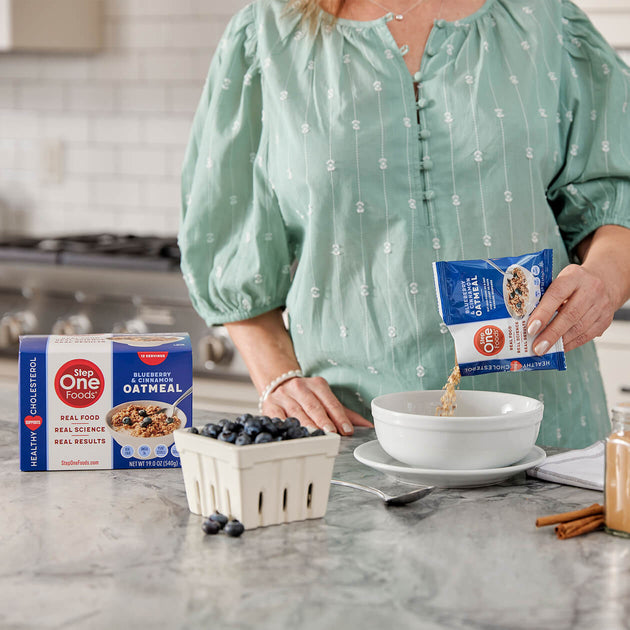
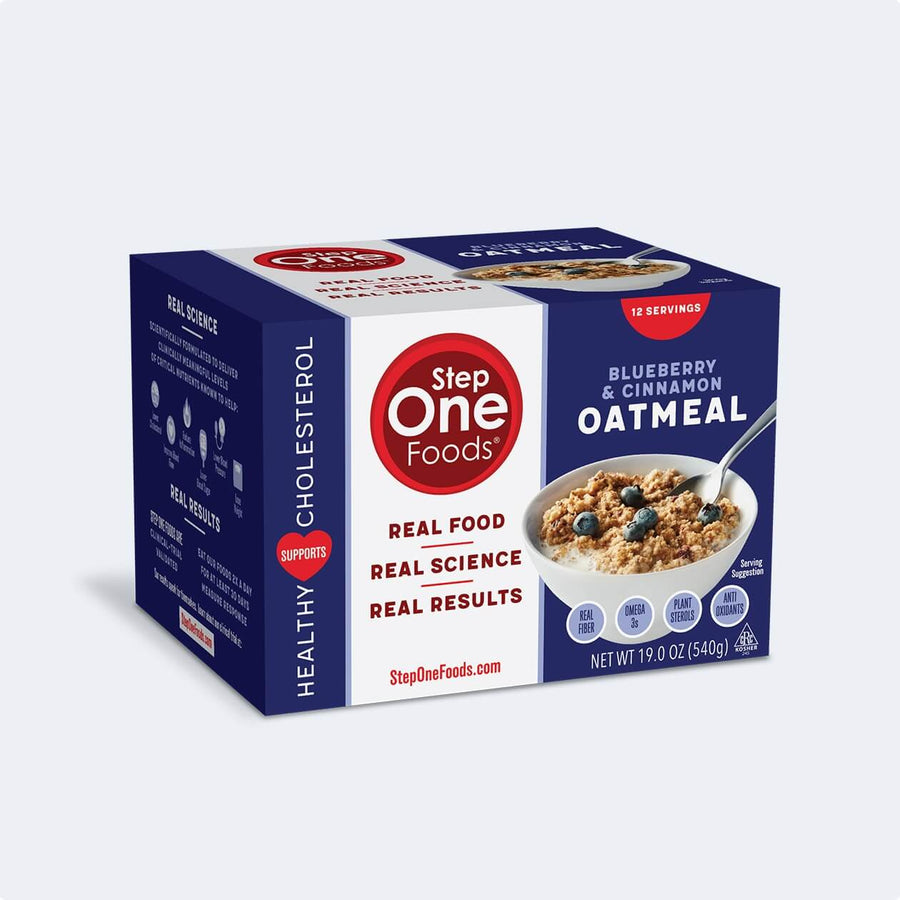
Blueberry and Cinnamon Oatmeal, built to carry soluble fiber, plant sterols, omega-3 ALA and antioxidants in one bowl. Eat it in place of the oatmeal you were already making.
“I was already having oatmeal every morning, so I switched to the Step One oatmeal.”Robin E. · Verified customer
Free shipping over $99
30-day guarantee
HSA/FSA eligible
Cardiologist formulated
Studied at Mayo Clinic
Blueberry & Cinnamon Oatmeal
4.8 · Based on hundreds of published customer testimonials
Real blueberries, nuts and cinnamon, built on the four nutrients tested in the trial. One serving, in place of the bowl you were already eating.
37.6% peak and 8.8% average LDL drop in 30 daysIn a double-blind randomized crossover trial published in The Journal of Nutrition, adults with high cholesterol who ate two Step One servings a day for four weeks lowered LDL cholesterol by an average of 8.8 percent - and as much as 37.6% - without changing anything else.
Soluble fiber, plant sterols and omega-3 ALA in every serving
Gluten free, dairy free, vegan, non-GMO
Free shipping over $99
30-day money-back guarantee
Blueberry & Cinnamon Oatmeal
$32.95
From people who were already eating oatmeal
4.9Across hundreds of published customer testimonials
Robin E.
Verified BuyerAugust 2025
In ONE month: Total Cholesterol went from 230/240's to 187. LDL went from 130's/140's to 90. My diet and my weight were already very good and I exercise regularly, so I could not imagine this actually would work! This was my last effort at lowering my cholesterol naturally before going on a statin. I was already having oatmeal every morning, so I switched to the Step One oatmeal.
Ed V.
Verified BuyerApril 2025
In just over 4 months of using the Blueberry & Cinnamon Oatmeal product daily, strong nutrition and exercise I have seen great results. Total Cholesterol has dropped 26 points (219 to 193), Triglycerides decreased 103 points (215 to 112), HDL increased 6 points (38 to 44), LDL decreased 13 points (142 to 129) and VLDL decreased 19 points (39 to 20).
Blanca D.
Verified BuyerApril 2026
In September 2025 my cholesterol came at the highest I've ever had it. It came in at 259 and my doctor said I needed to be on statins. I refused and told him to give me 6 months to bring it down. I started Step One Foods religiously, 2 servings a day. I never miss my 2 servings. I always start my day with the oatmeal, add blueberries, almonds and walnuts sometimes. I use the bars as an afternoon snack. I just received my cholesterol results and now I'm at 199.
Step One Foods is food, not medication, and it is not a substitute for treatment your physician has recommended. If a statin is needed, a statin should be taken.
Better health starts with better information.
Join thousands who receive Dr. Klodas' insights on cholesterol, cardiometabolic health, and food-first strategies that actually work.
Choosing a selection results in a full page refresh.