Before you go — get the Cholesterol Lowering Guide
A cardiologist's plain English breakdown of what causes high cholesterol, the various treatments available, and the foods and supplements that can help.
No spam. Unsubscribe anytime.
You're all set!
Your Cholesterol Lowering Guide is confirmed — it'll be in your inbox in the next few minutes.
Cholesterol · Nutrition
Best Foods to Lower Cholesterol: 7 a Cardiologist Eats
Most lists get the foods right and the amounts wrong. Here is what each one actually has to deliver to lower LDL, and what that looks like on a plate.
Medically reviewed by Elizabeth Klodas, MD, FACC
Board-certified cardiologist · Founder, Step One Foods
Published July 2026·9 min read
Cardiologist-created
Studied at Mayo Clinic
Every claim sourced
The foods with the strongest LDL evidence are ordinary. The doses are not.
Search for foods that lower cholesterol and the same list comes back every time. Oats. Nuts. Fish. Avocado. Olive oil.
Most of that list is right. What it leaves out is how much you would have to eat.
That number is what decides whether your next lipid panel reads differently. A food either supplies enough of the compound that lowers LDL or it doesn't, and the distance between a token serving and a studied dose is usually wide.
So this goes food by food and gives you the amount the research actually used, along with what that amount looks like in a bowl.
1. Oats and barley, at 3 grams of beta-glucan a day
Beta-glucan, the soluble fiber in oats, binds bile acids in the gut and prevents their reabsorption, so the liver has to pull cholesterol out of circulation to make more.
Pooled across 28 randomized trials, 3 grams a day or more lowered LDL by 0.25 mmol/L, roughly 10 mg/dL. Barley does about the same at a median of 6.5 grams.
Three grams is roughly a cup and a half of cooked oatmeal. Not a packet. An instant packet carries closer to 1 gram, which is why a small weekday bowl rarely changes anything.
2. Nuts, at an ounce a day and preferably more
Across 61 controlled trials, each daily one-ounce serving of tree nuts lowered LDL by 4.8 mg/dL, and the effect kept improving above about 60 grams a day. Walnuts specifically came in at 5.7 mg/dL across 49 trials. Dose mattered more than which nut you picked. An ounce is about 23 almonds.
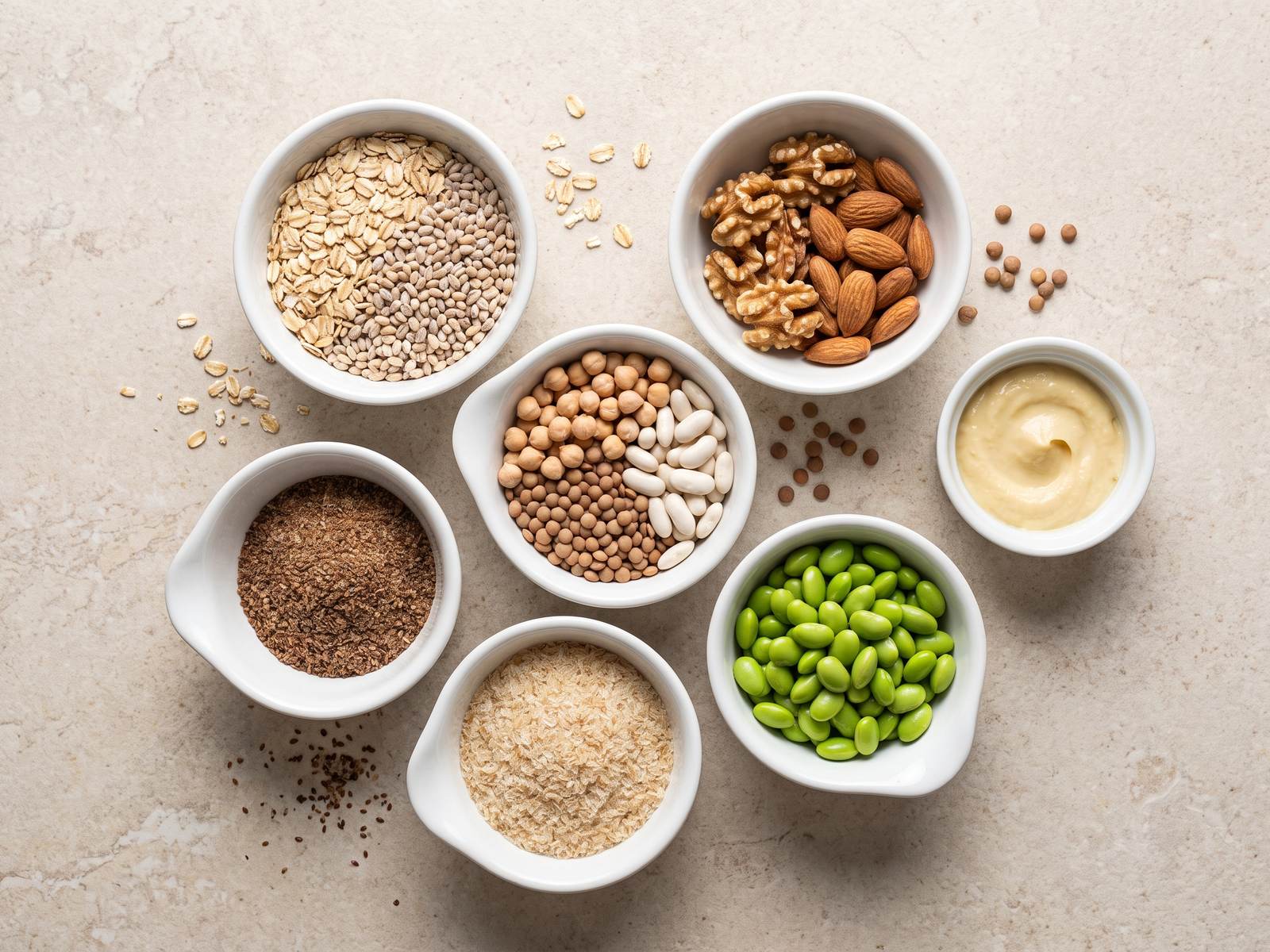
3. Beans, lentils and chickpeas, at about a cup a day
One serving of pulses a day, around 130 grams cooked, lowered LDL by 0.17 mmol/L across 26 randomized trials. Roughly 7 mg/dL. Of everything here this is the dose most people could actually hit without reorganizing their week, and the one most Americans skip entirely.
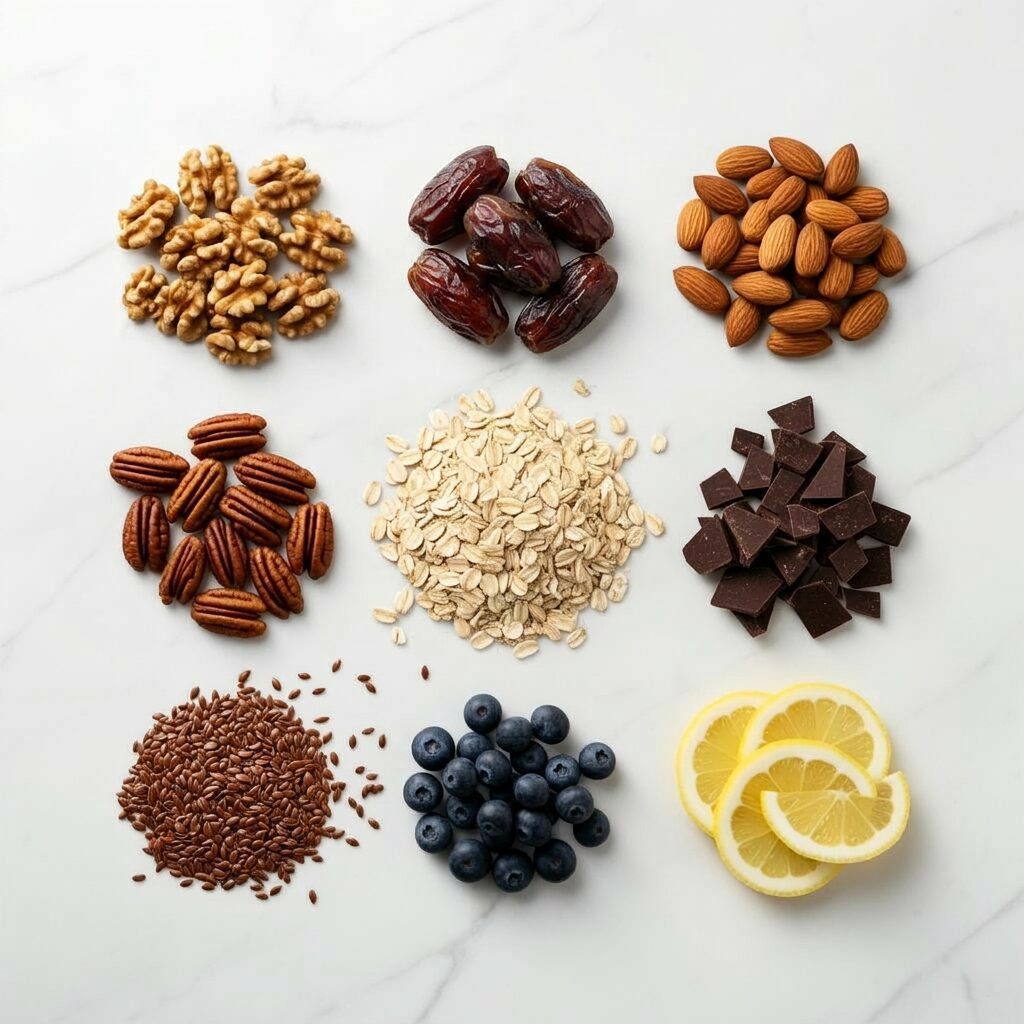
Oats, almonds, walnuts, flaxseed, blueberries. The evidence is in the amounts, not the ingredient list.
4. Ground flaxseed, not flaxseed oil
This distinction matters more than it sounds. Whole ground flaxseed lowered LDL by 0.16 mmol/L across 11 trials at 20 to 50 grams a day, about two to five tablespoons. Flaxseed oil did nothing to LDL, and neither did isolated lignan supplements. Press the oil out and you have left the active part behind.
5. Psyllium, at about 10 grams a day
The best-studied soluble fiber there is. Across 28 trials in 1,924 people, roughly 10 grams a day lowered LDL by 0.33 mmol/L, about 13 mg/dL, on moderate-certainty evidence. That is three rounded teaspoons of husk in water. It works, it is cheap, and most people quit within a month because of the texture.
6. Soy protein, at 25 grams a day
Reanalyzing the same 46 trials the FDA had assembled, 25 grams a day lowered LDL by 4.76 mg/dL. Real, and modest. That is about three cups of soy milk or twelve ounces of tofu, daily.
Worth adding honestly: in 2017 the FDA proposed revoking the soy heart-health claim it authorized in 1999, on the grounds that later evidence was inconsistent.
7. Plant sterols, at 2 grams a day
The most dose-predictable lever on this page, and the one no grocery run will solve. Pooled across 124 human studies, about 2 grams a day lowered LDL by 8.4 percent. Push to roughly 3 grams and the pooled figure reaches 12.4 percent.
Here is the problem. A normal diet supplies 200 to 400 milligrams of plant sterols a day. The dose that produces an 8.4 percent drop is 2,000. That is five to ten times what food alone delivers, and there is no vegetable you can eat enough of to close it.
The FDA's own sterol claim contains a detail worth borrowing: it requires the daily amount split across two eating occasions, at different times of day, with food. Sterols work on absorption, and absorption happens at meals.
Three foods on every list that can't carry it
Three things show up under every cholesterol headline without the evidence to justify the billing.
Avocado. The largest and longest test, 1,008 adults eating one avocado a day for six months, missed its primary endpoint and found only what the authors themselves called a modest, nominally significant change in LDL. Avocado is good food. It is not a cholesterol treatment.
Olive oil. A dose-response meta-analysis of 34 trials found that adding olive oil changed LDL by 0.04 mg/dL per 10 grams a day, which is to say not at all. Olive oil earns its place by replacing butter. Poured on top of an unchanged diet, it does nothing for LDL.
Green tea. Across 14 randomized trials, green tea lowered LDL by 2.19 mg/dL. Statistically real, clinically almost invisible, and it did not improve with a bigger catechin dose.
What happens when you stack them
Individually these foods produce small effects. Together they produce a large one.
The Portfolio diet is the formal version of stacking: viscous fiber, plant sterols, soy protein and nuts on a low-saturated-fat base. Pooled across seven controlled trials it lowered LDL by about 17 percent, on high-certainty evidence.
In one fully supplied one-month trial it lowered LDL by 28.6 percent, against 30.9 percent for 20 milligrams of lovastatin in the same study.
These are medication level reductions, achieved with food. Not drugs. Food.
The foods work. Getting the doses every day, from groceries, while living a normal life, is where it falls apart. Two tablespoons of flax, a cup of beans, an ounce of nuts, a cup and a half of oatmeal and 2 grams of plant sterols is not a snack. It is a part-time job.
What a cardiologist did about the gap
Elizabeth Klodas, MD, FACC spent years in preventive cardiology handing patients this same list, then watching their numbers barely move. The advice was right. The dose was never going to arrive from a grocery store.
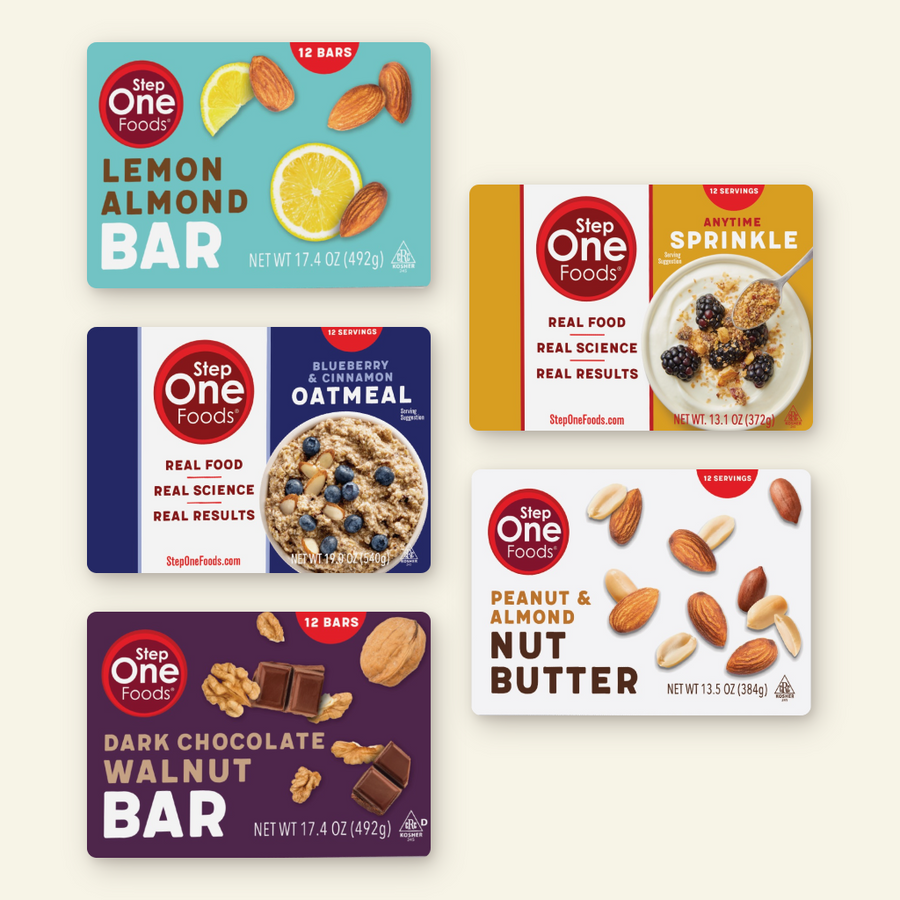
So she built the food instead. Step One Foods puts soluble fiber, plant sterols, omega-3s and antioxidants into oatmeal, bars, smoothie mix, nut butter and sprinkles at the amounts the research used, so hitting the dose means eating two things a day.
It was then tested the way a drug is tested, in a double-blind randomized trial published in The Journal of Nutrition. See what the trial measured or keep reading for the numbers.
54 adults with high cholesterol enrolled in a double-blind randomized crossover clinical trial at Mayo Clinic and the University of Manitoba. At four weeks, 80% of participants lowered their LDL cholesterol, some by as much as 37.6% (average reduction 8.8%), with no other dietary changes. Compliance, confirmed by blood testing, ran at 95 percent.
The trial found no significant change in triglycerides, HDL, blood sugar, insulin or inflammation. The effect was specific to LDL and total cholesterol, and that is the only claim worth making.
“The foods on every cholesterol list are the right foods. Patients weren't failing at willpower. They were being asked to hit a dose that groceries don't hand you.”
Elizabeth Klodas, MD, FACC · Board-certified cardiologist
From the published randomized trial
8.8%
average LDL drop
5.1%
average total cholesterol drop
4 weeks
trial length
95%
participant compliance
Kopecky SL, Alias S, Klodas E, Jones PJH. The Journal of Nutrition, 2022. Double-blind randomized crossover trial at Mayo Clinic and the University of Manitoba, 54 adults with hyperlipidemia, two servings daily.
Two servings a day
Real food. Real science. Real results.
The 30-Day Starter Pack is built around the amounts in the trial: bars, oatmeal, smoothie mix, nut butter and sprinkles, two servings a day for a month, then a re-test.
“I eat a healthy diet, lots of fruits and vegetables, but my cholesterol would not budge.”Nancy H. · Verified customer
Free shipping over $99
30-day guarantee
HSA/FSA eligible
Cardiologist formulated
Studied at Mayo Clinic
The 30-Day Starter Pack
4.8 · Based on 498 published customer testimonials
A month of the foods above at the doses the research used. Two servings a day, swapped for something you already eat.
8.8% average LDL drop in 30 daysIn a double-blind randomized crossover trial published in The Journal of Nutrition, adults with high cholesterol who ate two Step One servings a day for four weeks lowered LDL cholesterol by an average of 8.8 percent, without changing anything else.
Fiber, plant sterols, omega-3s and antioxidants in every serving
Twelve products across bars, oatmeal, smoothie mix, nut butter and sprinkles
Free shipping over $99
30-day money-back guarantee
The 30-Day Starter Pack
$170.75
From people who were already eating well
4.9Across 498 published customer testimonials
Nancy H.
Verified BuyerDecember 2025
I eat a healthy diet, lots of fruits and vegetables, processed or red meats, but my cholesterol would not budge. Have been using your products for about four months. Six months ago my total cholesterol was 227 and my LDL was 130. Blood test yesterday showed total cholesterol 198 and LDL at 98! I'm glad I took a chance on Step One foods!!
Leslie
Verified BuyerJanuary 2026
In spite of exercising regularly and eating a healthy diet, my LDL continued to climb over the past several years. I tried medication and had side effects so I thought I would try the Step One food in spite of my skepticism. My LDL decreased from 169 to 125 and as a side benefit, my HDL increased. I believe my LDL is now back to where it was eight years ago!
John G.
Verified BuyerMarch 2022
The last 10 years or so I have struggled to keep my total cholesterol below 200 even with a healthy diet. Part of that time I was Vegan and my numbers didn't improve much. In the fall of 2021 my Total Cholesterol was 189, HDL 44, LDL 121 and Triglycerides 122. My doctor didn't like the LDL being so high stating that it ideally should be below 100.
Step One Foods is food, not medication, and it is not a substitute for treatment your physician has recommended. If a statin is needed, a statin should be taken. Talk with your doctor before changing how you manage your cholesterol.
Effect sizes cited above are from the published trials linked in the sources list. Individual results vary.
Better health starts with better information.
Join thousands who receive Dr. Klodas' insights on cholesterol, cardiometabolic health, and food-first strategies that actually work.
Choosing a selection results in a full page refresh.