Cholesterol · Diet

High Cholesterol Diet: What to Eat and What to Avoid

A working guide with the actual amounts, including the parts a package label is legally allowed to leave out.

  • Cardiologist-created
  • Studied at Mayo Clinic
  • Current 2026 guidance
High Cholesterol Diet: What to Eat and What to Avoid
Front-of-package claims are marketing. The dose is on the back, if it is anywhere.

If you were told at your last appointment to fix this with diet, you were probably handed a sheet of paper with two columns on it. Eat more of this. Eat less of that. No amounts.

That sheet is where most people stall. They cut back on the red meat, buy the oat cereal with the heart on the box, come back in six months, and the number has barely moved. It is a demoralizing way to find out that the advice was directionally right and quantitatively useless.

So this guide leads with amounts. Where a food has been tested, the dose that was tested is here. Where something is widely believed and not well supported, that is here too.

The two columns, with amounts

Everything on the left has randomized-trial evidence behind it at the dose shown. Everything on the right either raises LDL or crowds out something that lowers it.

Eat more of this

  • Oats or barley3 g of beta-glucan a day, about 1.5 cups cooked
  • Beans, lentils, chickpeasabout a cup cooked, daily
  • Nutsan ounce a day, and more works better
  • Ground flaxseed2 to 5 tablespoons, ground seed not oil
  • Plant sterols2 g a day, split across two meals
  • Unsaturated oilsin place of butter, not on top of it
  • Fatty fishtwice a week, mainly for triglycerides

Cut back on this

  • Butter, cream, full-fat dairythe main saturated fat sources
  • Fatty cuts of red meatand processed meat
  • Coconut and palm oilsaturated, whichever aisle they sit in
  • Partially hydrogenated oilstill legal under 0.5 g a serving
  • Pastries and fried foodsaturated fat plus refined flour
  • Added sugarover 6 teaspoons a day for women, 9 for men

The saturated fat rule that almost everyone gets half right

The ceiling first. Federal guidance puts saturated fat at no more than 10 percent of daily calories. The American Heart Association goes further and recommends under 6 percent, which is roughly 13 grams a day on a 2,000-calorie diet. Both numbers are real; they come from different bodies with different thresholds for making a recommendation.

The half that gets dropped is what you eat instead.

The American Heart Association's 2017 advisory put the ceiling of this effect plainly: trials that replaced saturated fat with polyunsaturated vegetable oil reduced cardiovascular disease by about 30 percent, which the advisory itself compared to the reduction achieved by statin treatment.

Cochrane's long-term pooled analysis is more measured. Cutting saturated fat for two years or more reduced combined cardiovascular events by 17 percent, with no measurable change in death rates. Both of those findings can be true at once, and holding them together is more useful than picking the one you like.

The practical version: dropping the butter matters most when olive oil, nuts or seeds take its place. Dropping the butter and eating a low-fat muffin instead is close to a lateral move.

What "heart healthy" on a package legally means

This is worth knowing precisely, because the phrase is doing a lot of work in most grocery carts.

There is a real FDA health claim about saturated fat, cholesterol and heart disease.

To carry it, a food has to clear three thresholds per serving: 1 gram or less of saturated fat, 20 milligrams or less of cholesterol, and 3 grams or less of total fat. Those are qualifying limits. They describe what a food does not contain.

Then there is the word healthy, which FDA finalized new rules for in December 2024. Under the old rule, fortified white bread, heavily sweetened yogurt and sweetened breakfast cereal could all legally be labeled healthy, while salmon, nuts, olive oil and avocados could not.

FDA fixed that. The new rule is still voluntary, its compliance date is 2028, and it remains a floor rather than a dose: a grain product qualifies with three-quarters of an ounce of whole grain and caps on saturated fat, sodium and added sugar.

The oat cereal with the heart on the front is the clearest case. FDA's soluble fiber claim requires a daily intake of 3 grams of beta-glucan, but a single serving only has to supply 0.75 grams to carry the claim on the box.

Four servings a day gets you to the dose the claim is actually about. Most people eat one and reasonably assume they are covered.

Trans fat, and the zero that is not zero

Artificial trans fat is mostly settled. FDA determined in 2015 that partially hydrogenated oils are no longer generally recognized as safe, and the last compliance date passed on January 1, 2021.

One piece of it survives on the label. Under federal labeling rules, a food with less than 0.5 gram of trans fat per serving may declare that amount as 0 grams.

So a panel reading zero grams of trans fat is a rounding convention. If partially hydrogenated oil appears in the ingredients list, the food contains some, and eating three servings of it means eating three of those rounded-down amounts.

Reading the ingredients list beats reading the panel here.

Three things that matter less than their reputation

Dietary cholesterol

The 300 milligrams a day cap is gone from federal guidance, and the American Heart Association's 2019 advisory concluded that a single number was hard for people to act on. Saturated fat intake tracks with blood LDL.

Dietary cholesterol, eaten in a diet that is otherwise low in saturated fat, largely does not. If you have been skipping the eggs and eating the bacon beside them, the priority was inverted.

Salt

Cutting sodium lowers blood pressure, meaningfully so in people with hypertension. In pooled randomized trials it did not lower LDL cholesterol. Salt is worth managing on its own terms. It is not a cholesterol lever, and treating it as one is how people end up with a bland diet and an unchanged lab report.

Alcohol

Alcohol raises HDL cholesterol, which is measured and real. It does not lower LDL, and in pooled intervention studies it did not move triglycerides either. Current federal guidance simply advises drinking less for better overall health.

Added sugar deserves more attention than it gets here

Sugar is usually filed under triglycerides and weight, and it does hit those hardest. But in pooled randomized trials, higher intake of free sugars raised LDL cholesterol by 0.12 mmol/L as well, and the effect held even when calories were accounted for.

The American Heart Association's ceiling is 100 calories a day of added sugar for most women and 150 for most men, about 6 and 9 teaspoons. A single sweetened yogurt or flavored coffee can spend the whole allowance before lunch.

What a real dose looks like in a day

Stack the levers and the effect gets large. The Portfolio dietary pattern, which puts nuts, plant protein, viscous fiber and plant sterols on a low-saturated-fat base, lowered LDL cholesterol by about 17 percent across pooled controlled trials.

Here is what hitting that looks like on an ordinary Tuesday.

Every day, not most days:

  • A cup and a half of cooked oatmeal, for 3 g of beta-glucan
  • An ounce of almonds or walnuts
  • A cup of lentils or black beans
  • Two tablespoons of ground flaxseed
  • 2 g of plant sterols, split between two meals
  • Enough unsaturated fat displacing butter to move saturated fat under 6 percent of calories

That is achievable. It is also, for most people who work and cook for other people, a second job.

The 2 grams of plant sterols is the item that stops the list cold: ordinary food supplies 200 to 400 milligrams a day, so the target is five to ten times what groceries hand you, and no vegetable closes that gap.

This is the honest reason diet advice underperforms. Not because the foods are wrong. Because the amounts are hard to hit, every day, for the months it takes to matter.

If the dosing is the part that keeps failing, that is a solvable problem. See how the doses were built into food or keep reading.

A cardiologist's answer to the two-column sheet

Elizabeth Klodas practiced preventive cardiology for years handing out a version of the sheet at the top of this page. The patients who tried hardest were often the ones who came back most discouraged, because they had genuinely changed how they ate and the lab result did not agree.

She stopped handing out the list and put the amounts into food instead.

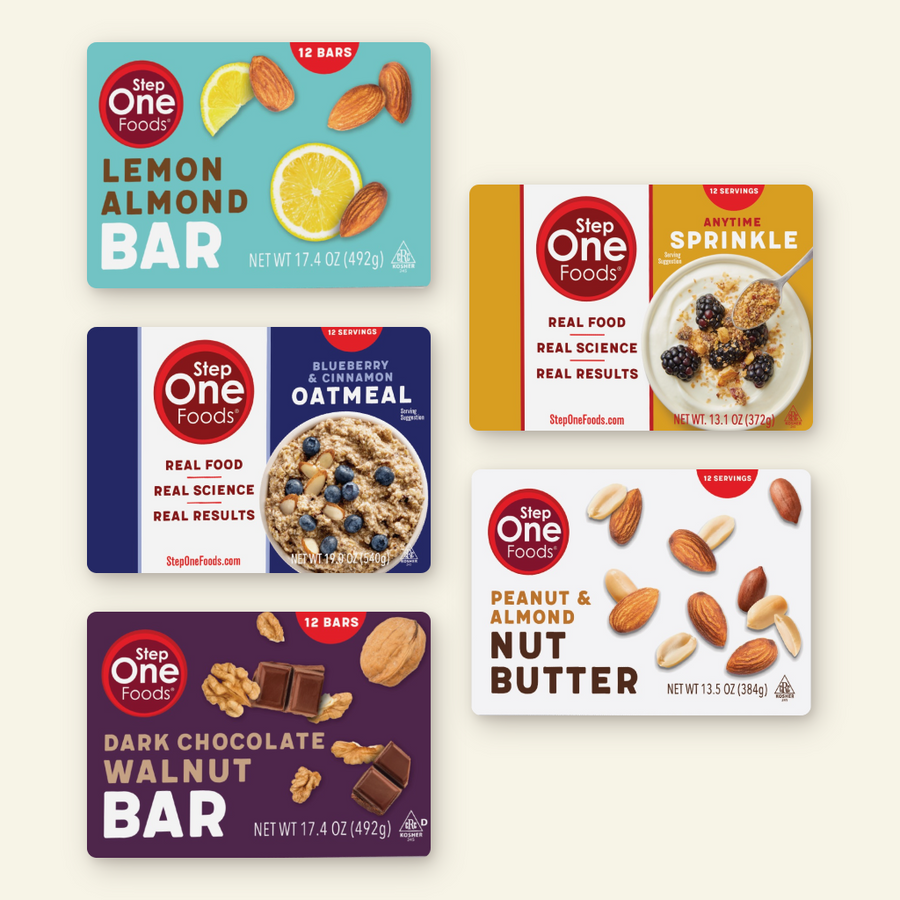
Step One Foods builds fiber, plant sterols, omega-3s and antioxidants into oatmeal, bars, smoothie mix, nut butter and sprinkles at the levels used in research, so reaching the dose means eating two things a day rather than rebuilding every meal around a spreadsheet.

It was then tested the way a drug is tested. In a double-blind randomized crossover trial published in The Journal of Nutrition, 60 adults with high cholesterol enrolled across two sites and 54 completed.

They ate two servings a day for four weeks and changed nothing else. Average LDL cholesterol fell 8.8 percent, total cholesterol fell 5.1 percent, and compliance, confirmed by blood testing, ran at 95 percent.

The trial found no significant change in triglycerides, HDL, blood sugar, insulin or inflammation. LDL and total cholesterol are the claims, and they are the only ones worth making.

“Patients were not failing at willpower. They were being asked to hit a dose that a grocery store does not hand you.”

Elizabeth Klodas, MD, FACC · Board-certified cardiologist

From the published randomized trial
8.8%
average LDL drop
5.1%
average total cholesterol drop
4 weeks
trial length
95%
participant compliance

Kopecky SL, Alias S, Klodas E, Jones PJH. The Journal of Nutrition, 2022. Double-blind randomized crossover trial, 54 adults with hyperlipidemia, two servings daily.

Two servings a day

Real food. Real science. Real results.

The 30-Day Starter Pack puts the amounts from the left-hand column into food you swap for something you already eat. A month, then a re-test.

30-Day Starter Pack

“My diet has been heart healthy for years but nothing seemed to help.”Hollie W. · Verified customer

Free shipping over $99
30-day guarantee
HSA/FSA eligible
Cardiologist formulated
Studied at Mayo Clinic

The 30-Day Starter Pack

4.8 · Based on 498 published customer testimonials

Fiber, plant sterols, omega-3s and antioxidants at research amounts, in bars, oatmeal, smoothie mix, nut butter and sprinkles.

8.8% average LDL drop in 30 days In a double-blind randomized crossover trial published in The Journal of Nutrition, adults with high cholesterol who ate two Step One servings a day for four weeks lowered LDL cholesterol by an average of 8.8 percent, without changing anything else.
  • 2 g of plant sterols a day across two servings, the dose the research used
  • Twelve products, so two servings a day stays realistic for a month
  • Free shipping over $99
  • 30-day money-back guarantee
Purchase Options $3.00 per serving
$0.00 each
0.00
Purchase Options
Selling Plans
$179.75
$179.75
each
$179.75
$179.75
each
 Deliver every 30 days
  • Save 20% on every order, automatically
  • Free shipping on orders $99+
  • Skip, pause, or cancel anytime
  • Backed by a 30-day money-back guarantee

30-day money-back guarantee · HSA/FSA eligible

People who had already changed how they ate

4.9 Across 498 published customer testimonials
Hollie W.   Verified BuyerJune 2026

My journey fighting cholesterol is a long one. Have various health issues that contribute to the fight and cannot jump on the exercise bandwagon as far as aerobics but I do walk. My diet has been heart healthy for years but nothing seemed to help. Absolutely did not want to go on statins but being genetically prone to have cholesterol issues, it was time. But then a Step One ad popped up. It made sense. So I gave it a try. Total cholesterol went from 305 to 258.

Michelle   Verified BuyerNovember 2024

I used Step One Foods for 30 days and I'm amazed at the results! My labs prior to this regimen were Chol 233, Trig 82, HDL 107 & LDL 110. Now it's Chol 200, Trig 60, HDL 114 & LDL 74. My favorite products are the smoothie mix & the anytime sprinkle. I will continue using these products because it tastes good, it's heart healthy & it works!

Chris J.   Verified BuyerApril 2026

The last 3-4 years my doctor told me my cholesterol numbers were not normal and creeping up. Last year he really wanted to push statins but I told him not yet, I wanted to try something else first. Fully intending to take the statins if my numbers were not in range at my next test, I searched for solutions. I ran across the Step One site and read the testimonials. I just got my test results back moments ago and everything is in the green, normal where previously they all stated abnormal.

Sources

  1. HHS/USDA. Dietary Guidelines for Americans, 2025–2030.
  2. American Heart Association. Saturated Fats (consumer guidance).
  3. Mensink RP. Effects of saturated fatty acids on serum lipids and lipoproteins: a systematic review and regression analysis. World Health Organization, 2016.
  4. Sacks FM, et al. Dietary Fats and Cardiovascular Disease: a Presidential Advisory From the American Heart Association. Circulation, 2017.
  5. Li Y, et al. Saturated Fats Compared With Unsaturated Fats and Sources of Carbohydrates in Relation to Risk of Coronary Heart Disease. J Am Coll Cardiol, 2015.
  6. Hooper L, et al. Reduction in saturated fat intake for cardiovascular disease. Cochrane Database of Systematic Reviews, 2020.
  7. US FDA. Final Determination Regarding Partially Hydrogenated Oils, 2015.
  8. 21 CFR 101.9 — Nutrition labeling of food (trans fat rounding rule).
  9. 21 CFR 101.75 — Health claim: dietary saturated fat and cholesterol and risk of coronary heart disease.
  10. US FDA. Use of the Healthy Claim on Food Labeling (final rule, December 2024).
  11. US FDA. Front-of-Package Nutrition Labeling (proposed rule, docket FDA-2024-N-2910).
  12. Carson JAS, et al. Dietary Cholesterol and Cardiovascular Risk: a Science Advisory From the American Heart Association. Circulation, 2019.
  13. 21 CFR 101.81 — Health claims: soluble fiber from certain foods and risk of coronary heart disease.
  14. Brown L, Rosner B, Willett WW, Sacks FM. Cholesterol-lowering effects of dietary fiber: a meta-analysis. Am J Clin Nutr, 1999.
  15. Ras RT, Geleijnse JM, Trautwein EA. LDL-cholesterol-lowering effect of plant sterols and stanols across different dose ranges. Br J Nutr, 2014.
  16. Chiavaroli L, et al. Portfolio Dietary Pattern and Cardiovascular Disease. Prog Cardiovasc Dis, 2018.
  17. Graudal NA, et al. Effects of low sodium diet versus high sodium diet on blood pressure, renin, aldosterone, catecholamines, cholesterol and triglyceride. Cochrane Database of Systematic Reviews, 2020.
  18. Te Morenga LA, et al. Dietary sugars and cardiometabolic risk: systematic review and meta-analyses. Am J Clin Nutr, 2014.
  19. Johnson RK, et al. Dietary Sugars Intake and Cardiovascular Health: a Scientific Statement From the American Heart Association. Circulation, 2009.
  20. Brien SE, et al. Effect of alcohol consumption on biological markers associated with risk of coronary heart disease. BMJ, 2011.
  21. 2026 ACC/AHA/Multisociety Guideline on the Management of Dyslipidemia. J Am Coll Cardiol / Circulation, March 2026.
  22. Kopecky SL, Alias S, Klodas E, Jones PJH. Reduction in serum LDL cholesterol using a nutrient compendium in hyperlipidemic adults unable or unwilling to use statin therapy. J Nutr, 2022.
  • Cardiologist-created
  • Studied at Mayo Clinic
  • Real food, not supplements

Step One Foods is food, not medication, and it is not a substitute for treatment your physician has recommended. If a statin is needed, a statin should be taken. Talk with your doctor before changing how you manage your cholesterol.

Effect sizes above are from the published trials and federal documents linked in the sources list. Individual results vary.